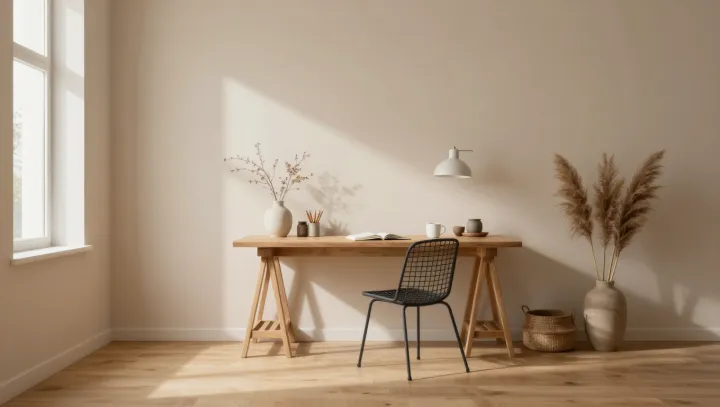
Soft light on an almost empty desk is not aesthetics. It is cognitive triage. Under harsh illumination and dense decor, the visual cortex fires continuously, pushing the prefrontal cortex to run constant selective attention, the brain’s costly filter for deciding what to ignore.
The blunt claim is this: every object in view taxes you. Each mug, sticky note, and cable becomes a stimulus that enters early visual processing, then competes in the attentional bottleneck described by cognitive load theory. Working memory, already limited to a handful of chunks, spends scarce capacity suppressing irrelevant inputs before it can even hold the problem you say you care about.
Minimal surfaces reverse that energy flow. Few edges. Few colors. Fewer contrast shifts. With less sensory input, baseline activation in the dorsal attention network drops, so neural resources can be reallocated to executive functions like task switching and error monitoring. Soft, indirect lighting reduces glare and micro‑saccades, which in turn lowers oculomotor strain and the metabolic cost of sustained fixation on a screen or page.
Natural textures add a quiet twist. A single wooden surface or a plant introduces low‑complexity patterns that research on biophilic design links to reduced activity in stress circuits, including the amygdala and hypothalamic–pituitary–adrenal axis. Lower arousal means less background noise in the same prefrontal regions you rely on for reasoning, so deep focus stops feeling like a fight and starts to feel simply available.