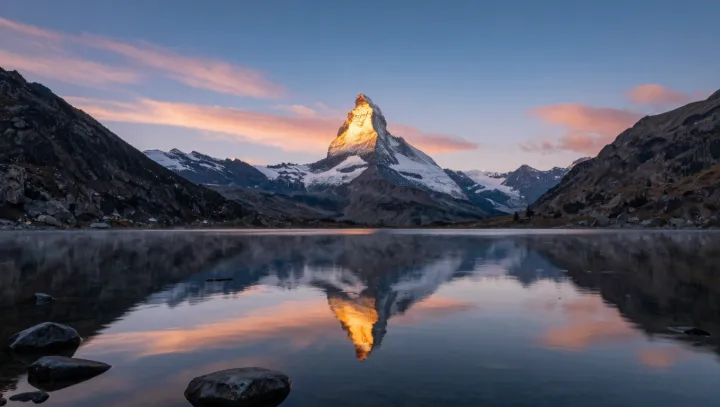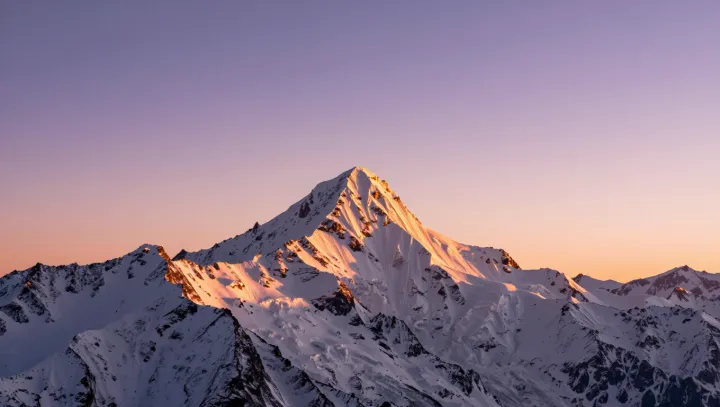
Pink fire on a white summit is not romance; it is ruthless filtering. While the Sun sits low, its rays travel a long, slant path through the atmosphere, a column of air far thicker than at midday, so shorter blue wavelengths are stripped away by Rayleigh scattering before they ever touch the snow.
Down in the valley, the story is harsher. The valley floor often sits in geometric shadow, lit mostly by diffuse skylight that has already lost many reds to both Rayleigh scattering and selective absorption by gases such as ozone. What remains is a spectrum skewed toward blue, so rock, forest, and even snow there reflect a cooler, duller mix of wavelengths with little direct solar input.
Higher on the ridge, the geometry flips the advantage. Snowpack facing the Sun intercepts the reddened beam that survived the long atmospheric path, a beam depleted in blue but still rich in longer red and near‑infrared wavelengths. Because snow has high albedo across the visible range, it bounces that warm‑weighted spectrum straight to an observer, so the surface blazes with pinks and golds that are already baked into the incoming light, not created on the ground.
This split screen between summit and valley exposes the atmosphere as an active optical filter, not a passive window. By stretching the optical path length and amplifying wavelength‑dependent scattering and absorption, the air silently edits sunlight, leaving mountaintops to catch the last saturated reds while the lowlands sit in a washed‑out, blue‑heavy afterthought.