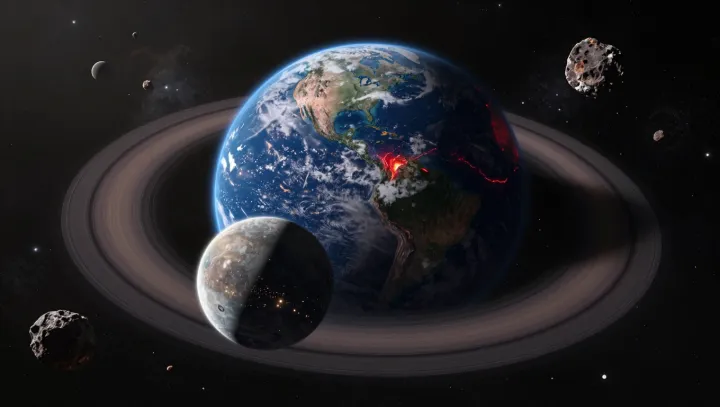
The Moon is far less passive than it looks. Its pull does not stop at the shoreline; it reaches upward into the sky and inward through skin and bone. Ocean tides are only the most visible output of a single physical script: Newtonian gravity acting on a rotating sphere covered in mobile fluid.
Less discussed is the air. Atmospheric tides, driven by the same gravitational gradient that lifts seawater, create regular oscillations in air pressure and wind high above the ground, superposed on heating from sunlight. Instruments detect these pressure waves circling the planet, with amplitudes of just a few pascals, yet they recur with the same rhythm as the ocean’s rise and fall.
Most unsettling is that your body participates. Human tissue is largely water, so tidal forces do stretch and compress it, though by fractions of a millimeter. Still, biology listens to small signals. Studies link lunar phase and gravitational forcing to shifts in melatonin secretion, sleep timing and seizure incidence, suggesting that circadian clocks and neuroendocrine feedback loops are not entirely indifferent to the Moon’s nightly pass.
So the familiar bright disk overhead is not only scenery; it is an ongoing experiment in how a single gravitational field can choreograph oceans, atmosphere and flesh at once.