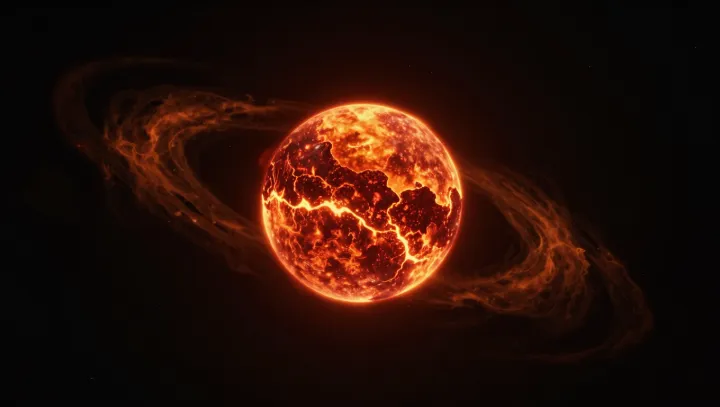
Glowing rock should cool. Fast. Yet physics quietly rigs the game in favor of a long, lingering fire. Inside a planet-sized sphere of magma, unstable isotopes like uranium, thorium and potassium keep spitting out energy through radioactive decay, a slow but relentless power source that acts less like a spark and more like a built‑in nuclear battery.
More surprising is how the surrounding universe can keep stirring that battery. If this molten world once orbited a massive body, tidal heating would knead its interior, turning gravitational flexing into frictional heat, the same basic geophysics that powers volcanic activity on some moons. Even after being flung into interstellar space, residual orbital eccentricity or a captured moon could continue that internal grinding for astonishing spans of time.
The real accomplice, though, is insulation. Rock is a poor conductor; convection and conduction in a thick mantle leak heat only grudgingly, and a solidifying crust traps the incandescent interior like ceramic around a kiln. Add latent heat of crystallization as minerals freeze out of the melt, and the cooling curve stretches so far that a starless, wandering planet can remain a dim ember long after its parent sun is only a memory.