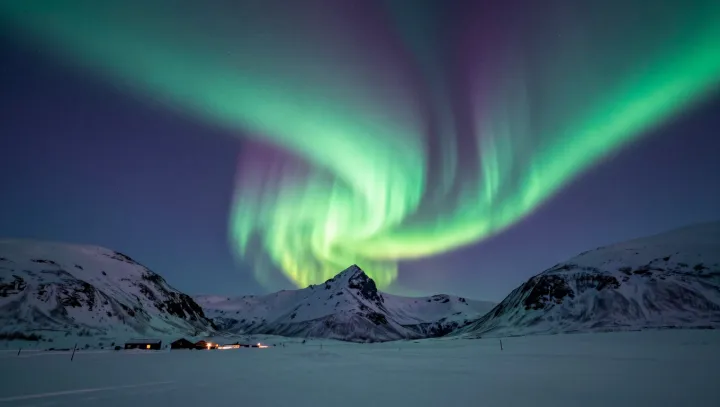
Auroral colors expose chemistry. Behind the northern lights' apparent curtains, oxygen and nitrogen emit distinct wavelengths after collisions with energetic particles, chiefly electrons, that enter the upper atmosphere along Earth's magnetic field lines. Beauty is the byproduct. Electron excitation supplies the energy; radiative decay releases it as light when excited atoms and molecules return to lower energy states.
Green deserves its dominance. Atomic oxygen produces the familiar green emission at about 557.7 nanometers, commonly from heights near 100 to 150 kilometers, where conditions allow that light to escape before collisions interrupt its production. Red demands more patience. Oxygen also emits red light near 630 nanometers, usually above roughly 200 kilometers, because the excited state responsible survives long enough in that thinner air to release a photon. Nitrogen complicates the palette. Molecular nitrogen and its ionized form contribute red, blue and violet emissions, whose combinations can give the lower edges of auroral curtains a pink appearance.
The curtains conceal structure. Their folds trace sheets of particle precipitation guided by the magnetic field, while their changing brightness reflects variations in incoming energy rather than atmospheric gas blowing like fabric in a breeze. Color needs careful interpretation. Altitude, particle energy and competing collisions all affect the display, so a photograph cannot serve as a simple gas chart, especially when cameras register faint reds more readily than human night vision. Darkness edits the evidence. Beneath a pale arc, the eye may see little color even as oxygen and nitrogen write their separate signatures across the same silent sky.