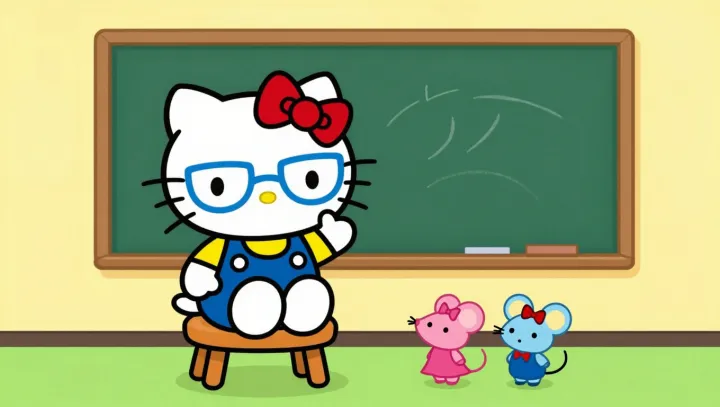
Silence can make claims. When Kitty raises her hand to speak, the gesture does something words need not yet do: it announces a wish to enter the conversation without interrupting its current speaker. Stillness is not passivity. Through a convention learned rather than dictated by anatomy, a lifted hand becomes a request that others can recognize before hearing its owner's voice.
Courtesy has its machinery. In conversation analysis, turn-taking describes how participants distribute opportunities to speak, while a hand raised for recognition can help manage that distribution where the convention is understood. The meaning is learned. Conventionalization gives a movement its shared significance, so the same physical action need not carry the same request in every setting or among every group. Recognition completes the signal. Kitty's movement can organize expectations only if others notice it and understand what it asks, making this apparently individual act dependent on knowledge held between participants.
Order is not equality. Although raising a hand offers a way to seek a speaking turn without competing through volume, the gesture itself cannot guarantee that its maker will receive attention or permission. Someone must still respond. Where a chair or teacher allocates turns, acknowledging the hand can grant access to speech, while overlooking it can leave the request unanswered without any explicit refusal. The pause contains politics. Before Kitty says a word, her hand poses a question about who may enter, who must wait, and whose silence will be mistaken for having nothing to say.