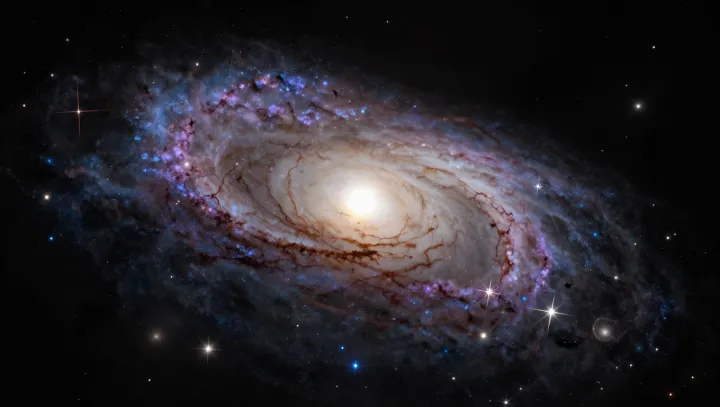
The stripes are obstructions. Across NGC 6956, reddish-brown markings owe their appearance not to luminous ribbons but to dust that intercepts light from stars behind it. Darkness does the explaining. Against spiral arms rich in hot, young blue stars, those lanes make the galaxy's visible structure partly a record of what its light cannot pass through.
Color needs cross-examination here. Interstellar extinction, the reduction of starlight by intervening matter, combines absorption with scattering, which redirects some photons away from the observer's line of sight. Blue suffers more losses. Because dust generally removes shorter visible wavelengths more efficiently than longer ones, transmitted starlight becomes redder, an effect astronomers call interstellar reddening. Dust is not paint. The lanes' appearance depends on the material, the stars behind it, and their arrangement, rather than on a reddish substance shining independently. Absence carries physical information. A dark stripe can therefore disclose matter that would be difficult to identify from visible emission alone.
The blue deserves scrutiny. Hot, young stars contribute strongly to the arms' blue appearance because their high surface temperatures favor more short-wavelength radiation than cooler stars produce. Brightness has its biases. Massive blue stars shine intensely but exhaust their fuel rapidly, so their presence points to relatively recent star formation rather than an ancient, unchanged population. The contrast resists simplicity. In the same view, brilliant stars announce their presence while dust declares itself by withholding the light that would otherwise fill its place.