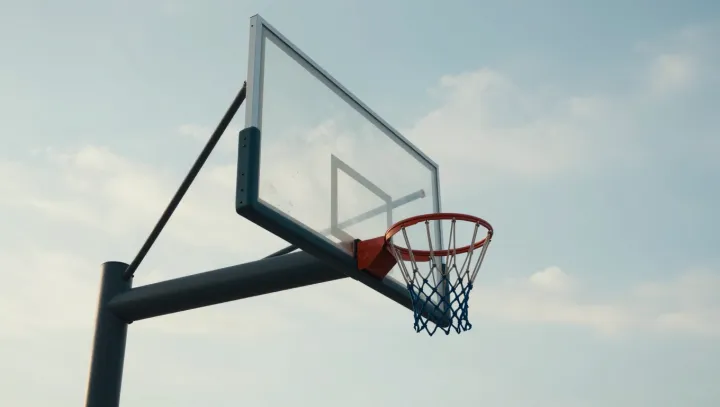
Basketball's defining measurement was architectural. The hoop stands 10 feet above the floor because that was the height of the gym balcony where James Naismith attached peach baskets, not because a calculation identified the ideal target for human movement. Convenience supplied the specification. What became a worldwide sporting constant began with the building available to its inventor in Springfield, Massachusetts.
The distinction deserves attention. Naismith devised basketball as an indoor activity at the institution now known as Springfield College, where the baskets served as goals above the playing floor. Their elevation outlasted their usefulness. Although peach baskets gave way to equipment designed for the sport, the regulation rim height remained 10 feet, preserving a measurement inherited from the gym rather than selected through comparative testing. Architecture had become a rule. Modern basketball's backboards, open nets and breakaway rims belong to a much more developed equipment system, but they still operate around that borrowed dimension.
Persistence is not proof of perfection. A fixed target gives players and coaches a shared reference for shooting mechanics, while identical rim heights allow performances on different courts to be compared under the same basic condition. That consistency has value. Yet it does not establish that 10 feet is the best possible height for every age, body or version of the game, and youth programs sometimes use lower baskets. The inheritance remains visible. Above polished courts and beneath arena lights, basketball still asks its players to reach toward a height first supplied by a balcony.