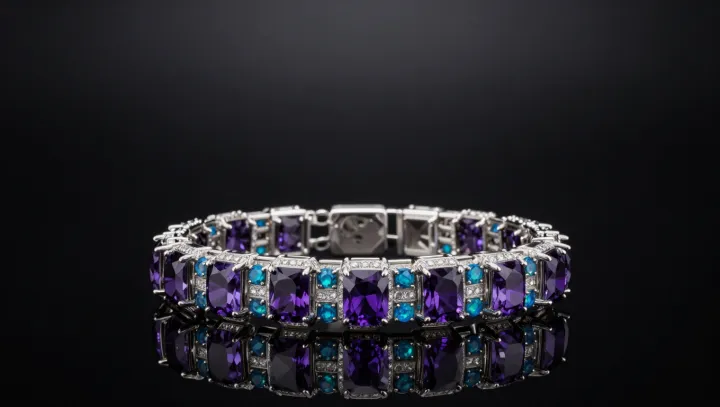
Bone, recast in precious metal, becomes the organizing principle of a new luxury jewelry collection that treats anatomy less as ornament and more as hypothesis. Instead of copying skeletal motifs for shock value, the collection abstracts vertebrae, joints and sutures into quiet, continuous lines, asking what happens when one of biology’s most fragile load-bearing structures is promoted to the realm of heirloom objects.
The design logic leans on evolutionary morphology and on the simple physics of stress distribution: ridges echo trabecular patterns, hinges suggest synovial joints, and stacked elements recall spinal segments adapting under mechanical load. By freezing those adaptive structures in metal, the pieces stage a tension between entropy and permanence. Bone, which in life is in constant remodeling through osteogenesis and resorption, is here arrested mid-process, turning metabolic flux into something like a fossilized baseline, a visual counterpart to a resting metabolic rate that never actually rests.
Metamorphosis enters through modularity and wear. Rings nest into cuffs, pendants pivot and rearticulate, mirroring how small mutations compound into large shifts in phenotype. Each configuration becomes a tiny experiment in form-finding, a private phylogenetic tree on the body. Luxury, in this context, is not only scarcity of material but scarcity of time: the time evolution took to engineer the original bone architectures, and the time the wearer spends recomposing them into new, provisional anatomies.