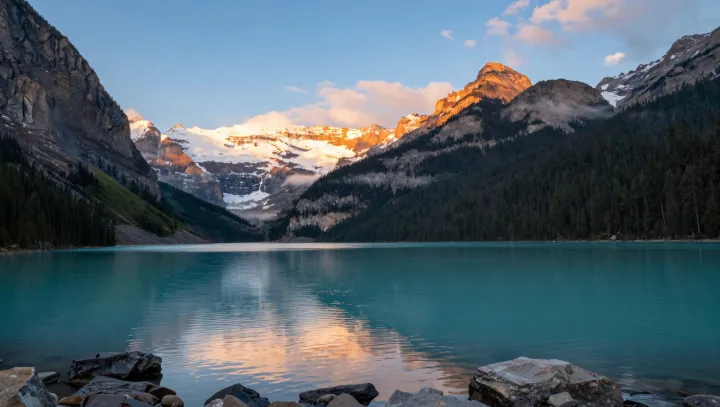
Glacier-fed lakes in Canada can appear digitally enhanced even in unedited photos: the water glows turquoise while distant peaks reflect with razor clarity in the same frame. The effect starts far upstream, where glaciers grind bedrock into ultra-fine sediment known as rock flour, then flush it into meltwater streams and, eventually, into large basins.
Each grain of rock flour is tiny enough to stay suspended rather than sinking, turning the lake into a natural colloid. Under sunlight, these particles drive selective light scattering, a textbook case of Mie scattering layered on top of Rayleigh scattering in the atmosphere. Longer red wavelengths are scattered and absorbed differently from shorter blue-green wavelengths, so the water column preferentially returns that distinctive turquoise band to a camera sensor or the human retina.
The mirror-like reflections coexist with the color because the same suspended sediment that tints the water is unevenly distributed with depth. Surface layers can remain optically smooth when wind is low, preserving specular reflection, while most rock flour resides slightly deeper, dominating the bulk color but not roughening the interface. With low surface turbulence and limited biological turbidity, the lake behaves like a stacked optical system: an upper reflective boundary over a colored scattering medium, producing both the saturated hue and the sharp alpine mirror without any digital manipulation.