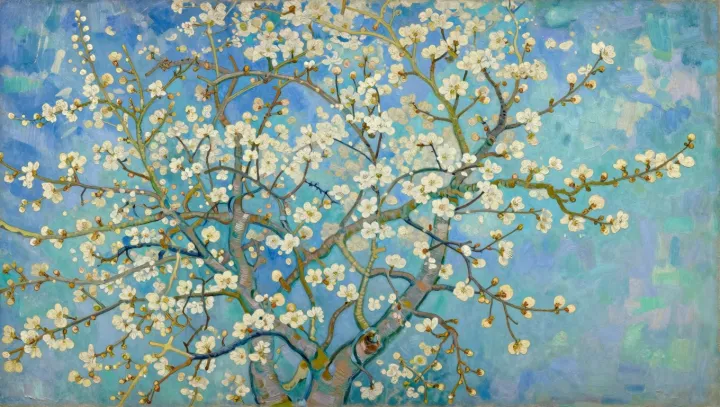
Pale-blue almond blossoms float across a canvas that refuses to admit the season in which it was painted. The branches are bare of background drama, the composition stripped to a few decisive diagonals, as if the image had been engineered to hold its own emotional equilibrium.
The painting emerged not in an outdoor spring orchard but inside a psychiatric hospital, where Van Gogh was testing how far color and line could regulate psychic entropy. By isolating the fragile blossoms against a flat sky, he turned them into variables in a controlled experiment: could a restricted palette, a stable surface and a deliberate brush rhythm counter the inner turbulence that kept surging back.
The calm is therefore not given; it is constructed. The pale blues act like a lowered emotional baseline, while the sharp contours prevent the scene from dissolving into sentimentality. Instead of dramatizing suffering, the work treats hope as a marginal effect produced by rigorous visual choices. Out-of-season flowers, painted under clinical supervision, become a precise study in how resilience can be staged, petal by petal, without ever claiming to cure the storm that made them necessary.