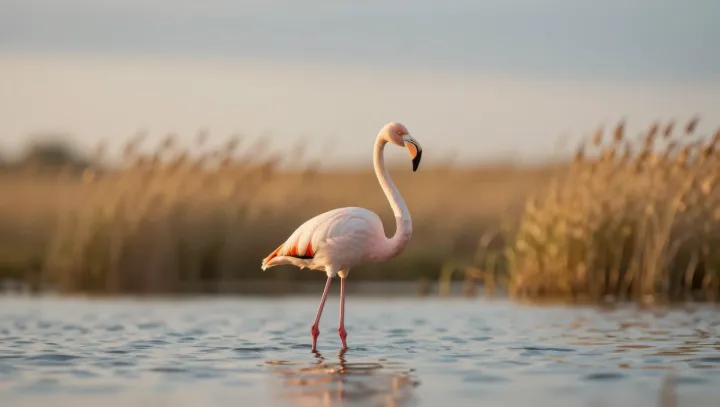
Mud-colored water shimmers and a line of flamingos snaps into motion, every head dipping, every body glowing almost unnaturally pink. The birds’ flamboyant look, gravity-defying sleep posture and crowd choreography are not quirks but the visible edge of some of the most demanding constraints in avian biology.
Flamingos start with drab raw material: shrimp and algae packed with carotenoid pigments. Inside the bird, enzymes in the liver and feather follicles repackage these molecules, routing them into growing plumage rather than simply burning them for basic metabolic rate. The brighter the feathers, the more effectively the bird has captured and reallocated dietary energy, turning pigmentation into a public signal of foraging success and physiological resilience that mates can quickly read.
The famous one-legged stance looks whimsical but behaves more like a mechanical lock. Studies of flamingo biomechanics show that once a leg is straightened, tendons and joints align so the body can rest with minimal muscular effort, reducing energy loss and limiting heat transfer through the bare limbs. The posture becomes a strategy of thermoregulation and entropy management: by cutting unnecessary movement and exposed surface area, the bird protects both warmth and balance over long, shallow stretches of water.
Then there are the mass “dance parties.” Large flocks pace, twist their necks and flap in synchrony, an apparent spectacle that functions as a sorting algorithm. Movements amplify visual access to plumage, synchronize hormone surges and compress mate choice into a brief, information-dense window. What looks like a festival at the water’s edge is, at cellular and social scales, a set of finely tuned negotiations between scarcity, display and survival.