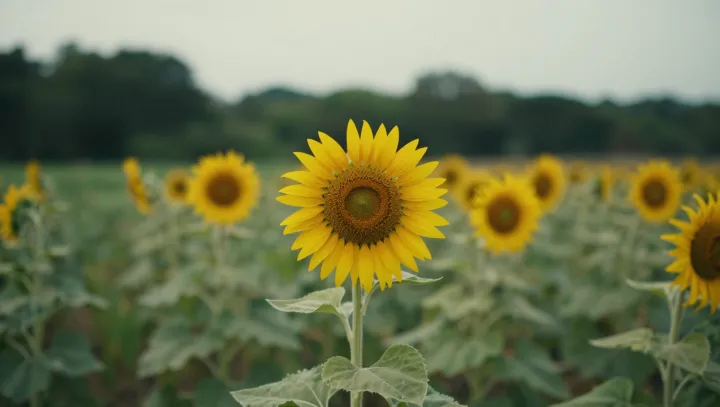
Sunflower heads are not pretty; they are engineered. Packed into each disk is a layout problem solved with the Fibonacci sequence and a constant offset called the golden angle, and that hidden order gives photographers a ready-made composition grid the moment a camera is raised.
Gallery-grade images start with structure, not sentiment. In a sunflower, florets emerge by phyllotaxis, each new seed sitting about 137.5 degrees from the last, which maximizes packing density while creating two clean spiral families radiating in opposite directions, and those arcs behave like built-in leading lines that can steer the eye straight to a chosen focal point. Get close. Rotate the frame until one spiral runs from a lower corner toward the center, then let the crossing spiral form a secondary path, and suddenly the chaos that clutters most flower shots collapses into a legible pattern the brain reads as intentional design.
The real upgrade is how this math controls depth and focus. Because the spirals expand almost logarithmically, each ring of florets changes scale at a steady rate, which makes selective focus far more predictable than on irregular petals; set a shallow aperture, lock focus on the point where several spirals intersect, and every out-of-focus loop around it will blur into a soft vortex that echoes the same geometry. Work with sidelight so that tiny shadows fall along the spiral arms, and the Fibonacci layout stops being an abstract number trick and becomes a visible scaffold your lens can exploit.