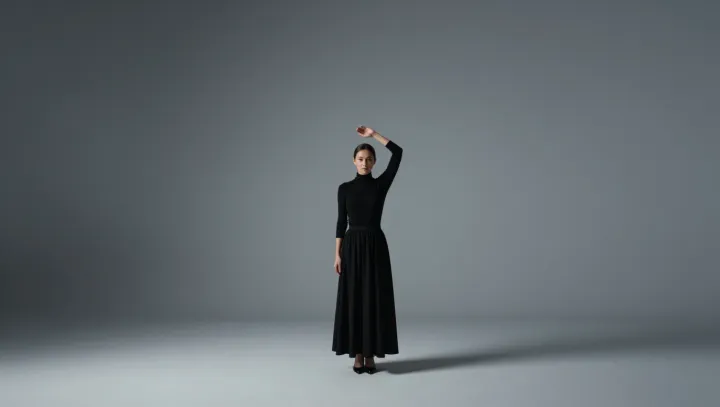
That black column does not retreat; it strikes. Against a pale minimalist set, the gown behaves less like clothing and more like graphic design, a single dark vector on a near‑blank canvas. High neck, long sleeves, floor length: by erasing skin breaks, the look consolidates the body into one continuous mass, exaggerating verticality and tightening the outline.
Power here is engineered, not implied. The sharp luminance contrast between matte black fabric and low‑saturation background acts like edge detection in human visual cortex, forcing the eye to lock onto the figure first and linger there longest. With no competing hues or textures, the silhouette becomes the main data point, so posture, shoulder line, and proportion read with almost architectural clarity.
Authority, too, is coded in the color. Studies on color psychology and enclosure show that black is read as dominance and control, especially when it forms a closed contour around the body. The high neck removes vulnerability at the throat; the long sleeve shields gesture. What could have dissolved into darkness instead becomes visual armor, cutting through all that pale space like a command.