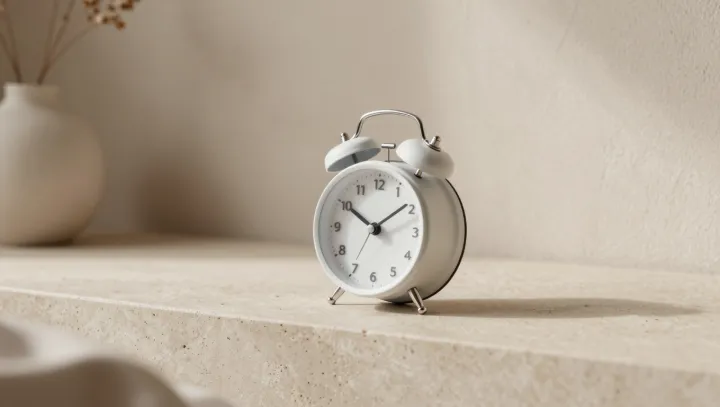
That stubborn analog alarm on the nightstand is a stricter sleep coach than any tracking app. Its fixed ring time, never updated by software or social plans, becomes a hard external cue that your internal clock, or suprachiasmatic nucleus, slowly learns to anticipate.
The bold claim is simple. Stable wake time matters more than chaotic bedtime. When the alarm fires at the same minute every morning, it anchors circadian rhythm, nudging melatonin secretion to shut down earlier and cortisol awakening response to peak on cue, which tightens the curve of core body temperature through the night.
That regularity then reshapes sleep architecture. With a non negotiable wake boundary, slow wave sleep clusters earlier, rapid eye movement episodes shift and compress, and homeostatic sleep pressure builds more predictably across the prior day, because the brain can model exactly how many hours remain until the bell.
The unromantic truth is that the clock works precisely because it does not adapt. No blue light filter, no smart snooze, no algorithm. Just a fixed mechanical deadline that, repeated across many cycles, entrains circadian phase as reliably as scheduled light exposure or timed melatonin, while sitting silently by the bed.