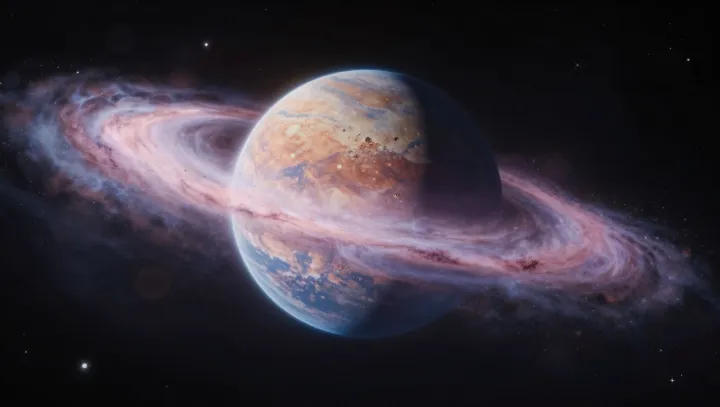
Darkness, not light, is the real clue to how the universe works. A crowded universe of stars should fill every line of sight, so basic geometry predicts a sky as bright as a stellar surface, an idea known as Olbers paradox in classical astronomy.
The escape route is not that there are too few stars. There are plenty. The key claim from modern cosmology is harsher: much of the light that could have lit the sky has been stretched, cooled, and pushed out of the visible band by cosmic expansion, described quantitatively by the Friedmann equations and Hubble parameter. Space itself grows; photon wavelengths grow with it; visible light drifts into infrared and microwave ranges, leaving only a pale residue for human eyes.
Equally important is a limit on how far we can see. A finite observable universe, set by the speed of light and the finite age of cosmic structure, caps the number of luminous surfaces that can contribute to the sky at any moment. Regions far beyond that horizon may teem with stars, but their radiation has not had enough time to arrive. Between galaxies, interstellar dust absorbs some starlight, but radiative transfer physics says that heated dust must re-emit energy, so absorption alone cannot rescue a static, eternal universe.
What remains above you at night is a kind of negative image: a few nearby stars, a faint galactic band, and behind them an invisible ocean of redshifted energy, recorded only as a thin wash of microwave background rather than a blinding white canopy.