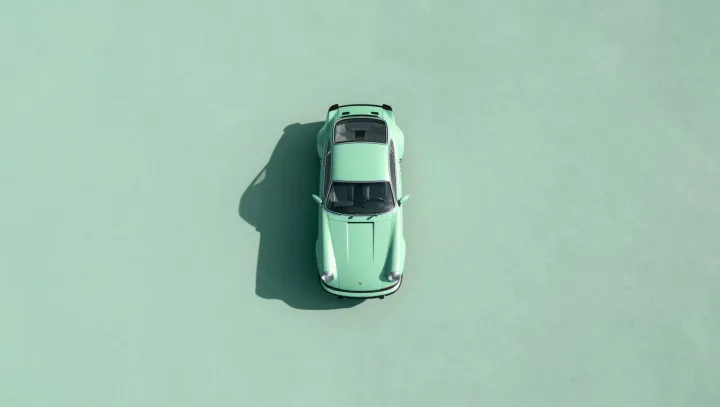
Luxury often hides in subtraction, not addition. A car isolated in pale mint against empty space looks expensive because the eye has nowhere else to go, and that forced attention reshapes judgment. With visual noise removed, the brain runs a kind of low-power mode on scene parsing, a reduction in cognitive load that experimental psychology links to higher ratings of fluency and quality. The shot feels easy to read, so the object inside it is unconsciously tagged as refined.
Status, in this frame, shrinks to tiny cues. Panel gaps, wheel design, paint gloss, even the radius of a door curve become legible because there is no clutter competing in the visual hierarchy. Perceptual systems built on selective attention and figure–ground segregation reward what stands alone; the car becomes the only figure, the mint field pure ground. That emptiness also mimics high-end brand identities, where negative space and tight color palettes signal budget for restraint rather than the need to shout.
What looks like a styling trick is really a staging of scarcity. One color, one object, too much quiet: the scene whispers that both the image and the car could afford to leave everything else out.