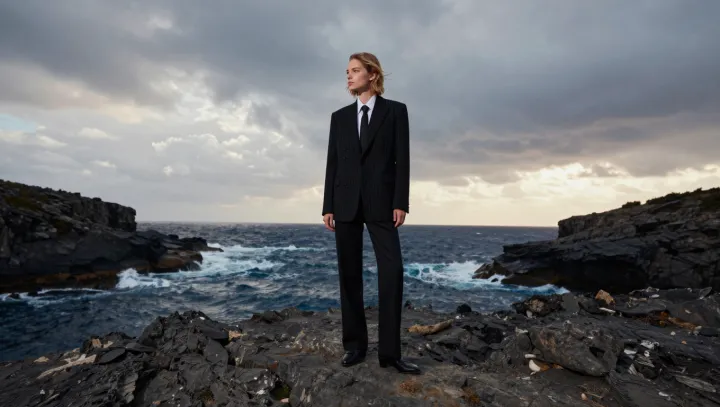
Authority, here, is an illusion that refuses to blink. A pinstripe suit stands on wet rock while waves smash and recoil, and the eye still reads the cloth first as command, not as vulnerability. Thin vertical lines echo the grammar of corporate power: trading floors, boardrooms, courtrooms, each space reinforcing a conditioned association between this pattern and control over capital, risk, and consequence.
What holds is not fabric strength but a mental shortcut. Social psychologists call it a status heuristic, a rapid rule that fuses cut, pattern, and posture into a judgment about rank. The coastline, with its random wave spectra and relentless erosion, should cancel any sense of human scale; instead, the contrast sharpens it. Against geological force, the tailored suit becomes a visual algorithm for order imposed on chaos, a portable architecture of straight lines facing fluid impact.
The paradox is that the setting intensifies the signal it ought to erase. When the suited figure is dwarfed by cliffs and spray, the brain stages a quiet contest between physical power and social power, and often crowns the latter. Centuries of institutional dress codes, from banking halls to legislative chambers, have drilled in the idea that vertical stripe plus structured shoulder equals decision maker, even when the sea, indifferent, keeps rewriting the shore.