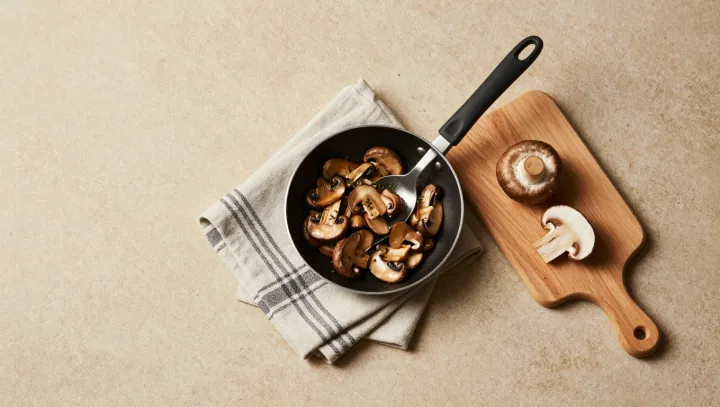
A crowded pan kills any hope of steak-like mushrooms. Spread in a single layer under high heat, this low-calorie fungus behaves like a lean cut of meat, not a damp side note, because its chemistry suddenly has room to work.
At the heart of this shift is aggressive water management. Mushrooms are mostly water, and packed together they steam, so cell walls soften without enough surface heat to trigger serious Maillard reaction, the browning process between amino acids and reducing sugars. When cooks raise the temperature and keep each piece exposed, water flashes off, surface temperature climbs past the boiling point of water, and browning accelerates. That dry, hot contact zone builds hundreds of new volatile compounds associated with roasted meat.
Even more counterintuitive is how a plant-based ingredient can taste so carnivorous. Mushroom tissues carry free glutamate and 5′-ribonucleotides such as guanylate, both classic umami agents in food science. Under intense heat, partial dehydration and mild protein denaturation concentrate these molecules at the surface, where saliva and enzymes later release them efficiently. Fat added to the pan acts as a carrier phase, dissolving aromatic compounds and helping them coat the palate, mimicking the lingering richness associated with animal fat.
Texture, too, is negotiated by heat and spacing. With enough room, excess moisture can escape before the cell network fully collapses, leaving a springy, fibrous bite rather than a spongy one. High surface heat encourages localized caramelization and slight charring at the edges, giving the teeth something to push against. What began as a watery vegetable ends up tasting, and chewing, like a pared-down, lean steak.