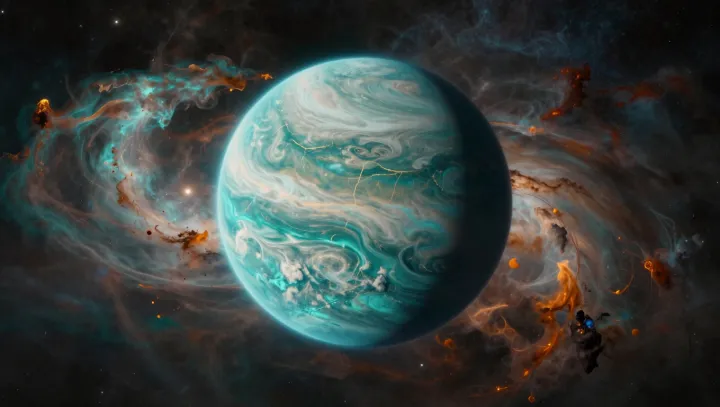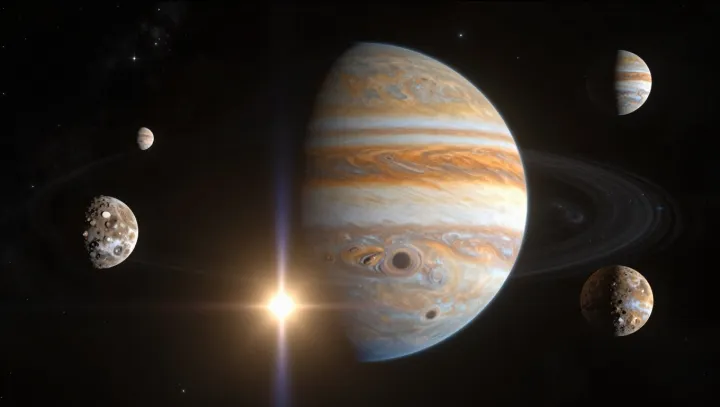
A giant world hugging its star is not a natural orphan; it is a migrant with baggage. A gas giant larger than Jupiter, yet racing around its star in a few days, almost certainly formed in the colder outer disk, where ice grains boosted the solid core and runaway gas accretion. Only once its envelope was in place did disk‑driven orbital migration, through torques known as type‑II migration, drag the planet inward while its newborn moons were already circling inside a compact swarm.
The surprising part is not that such a planet exists, but that its miniature system survives the move. As the planet spirals closer to the star, its Hill sphere—the region where its gravity dominates—shrinks, but not to zero; as long as the moons orbit well inside a few tens of percent of that radius, three‑body dynamics keep them bound. Some outer moons would be stripped, yet inner ones can be protected by tidal dissipation and mean‑motion resonances, which act like orbital shock absorbers that trade energy but preserve long‑term stability.
The real constraint comes from heat and tides, not simple gravity. Intense stellar irradiation puffs up the planet’s atmosphere while tidal heating inside the moons can melt ice and drive volcanism, but these processes operate within the Roche limit and do not automatically eject the satellites. The result is a shrunken but resilient moon system, pruned by the star yet still circling a bloated planet locked on a tight, blistering track.