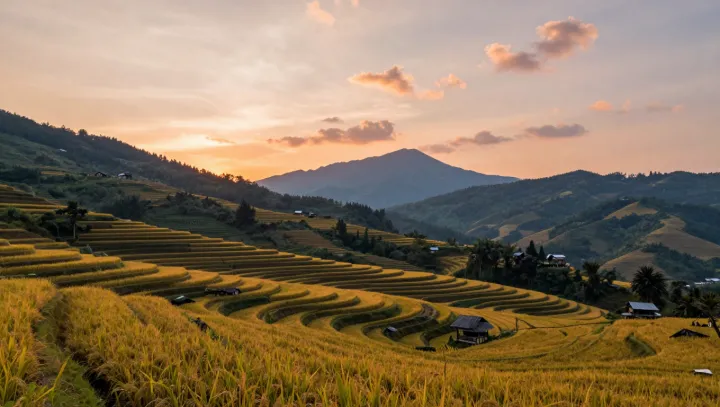
A single low sun looks inefficient; terraced fields disagree. Along a mountain flank, each narrow step tilts a slice of soil toward the same shallow solar angle, stretching the brief window of direct insolation that a simple slope would waste in shadow.
The core trick is geometry, not technology. On an uncut incline, the upper ground hogs the light while lower sections fall into self-shade as the sun skims the horizon, but a terraced profile breaks that long plane into dozens or hundreds of discrete facets, each with its own optimized surface normal that catches rays earlier after sunrise and later before sunset. Many of those facets sit near the angle of maximum projected irradiance, so for the same patch of hillside, the integrated solar energy per unit area can rise, even though the star in the sky has not changed.
Those bright bands are not just pretty; they act as a rough thermal device. Water in flooded paddies or moist soil raises local heat capacity, while the exposed water surface, with its higher albedo, bounces light onto adjacent risers like a field of small heliostats, though far cruder than engineered heliostat arrays used in concentrated solar power. That secondary reflection softens temperature gradients, dampens nocturnal cooling, and shifts the microclimate enough to nudge germination dates, pest cycles and evaporation rates. From a distance the hillside reads as ornament. At ground level it behaves more like a manual, centuries-old experiment in applied radiative transfer.
What looks like simple stone and soil, then, is a stacked calculation in angle, shadow length and reflectance, carried out every clear evening as the low sun fractures into a chain of bright, shallow pools.