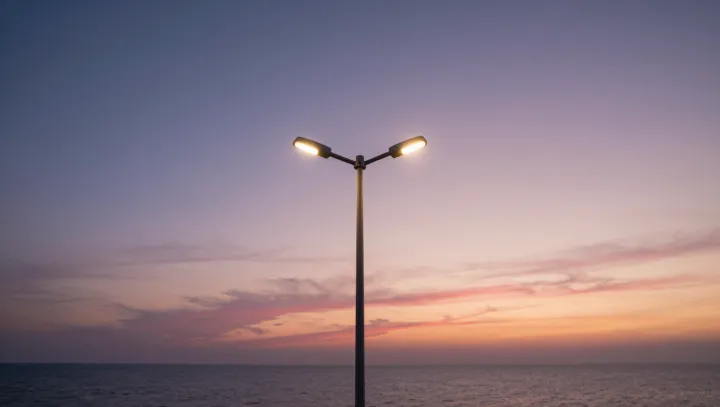
One glowing streetlight can feel softer than the sky that surrounds it. Against a pastel sunset, the harsh white LED looks almost like a promise of order, not an intrusion of glare. Vision science offers one blunt reason. The human retina shifts from cone-dominated photopic vision toward rod-heavy mesopic vision in low light, and that transition makes a single stable source feel safer and easier to parse than a fading, noisy horizon of color gradients.
More counterintuitive is that biology quietly mislabels the scene. Spectrally, many white LEDs sit close to midday sunlight, rich in short wavelengths that stimulate intrinsically photosensitive retinal ganglion cells and feed the central circadian pacemaker in the suprachiasmatic nucleus. Yet at dusk, overall luminance drops, pupils widen, and the brain weights context over spectrum, reading the streetlight not as daytime but as a modest anchor inside an otherwise darkening frame.
Culture finishes the trick. Repeated pairings of early evening with powered light, empty sidewalks and the slow shutoff of daily demands train associative memory to treat that first lamp as a cue for winding down. The pastel sky signals that obligations recede; the streetlight signals that structure remains. Between the two, the nervous system sees just enough control laid over just enough surrender.