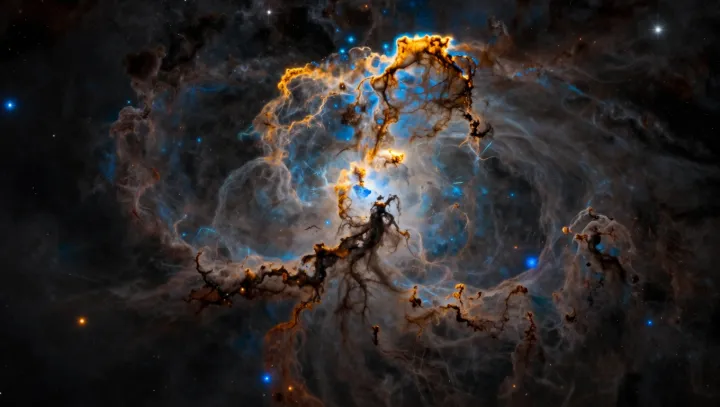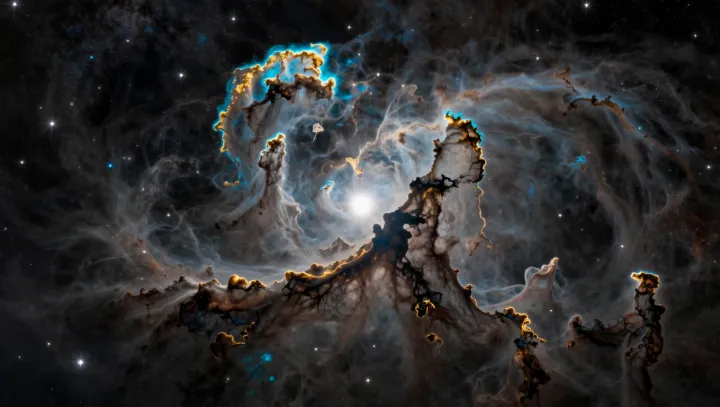
Size misleads here. A single massive infant star, though minute against its birth cloud, can flood its surroundings with ultraviolet photons and high‑speed particles. That energy output, set by nuclear fusion rates in its core and steep mass‑luminosity scaling, exceeds the power of many smaller stars combined and begins to strip nearby gas almost immediately.
What looks solid is really selection. Dense clumps inside a molecular cloud resist erosion, while less dense gas around them is ionized into an H II region, heated, and pushed away by radiation pressure and stellar wind. As photoionization and photoevaporation peel off exposed layers, only shielded columns remain, aligned with the direction of the radiation field and pointing back toward the hottest stars that sculpt them.
The real surprise is how far this influence reaches. Because nebular gas is extremely low density, even modest momentum input from stellar wind and expanding ionization fronts can clear cavities across many light‑years, leaving narrow pillars capped by star‑forming knots. Against the apparent bulk of the cloud, the stars look small; in terms of luminosity and momentum injection, they dominate the entire scene.