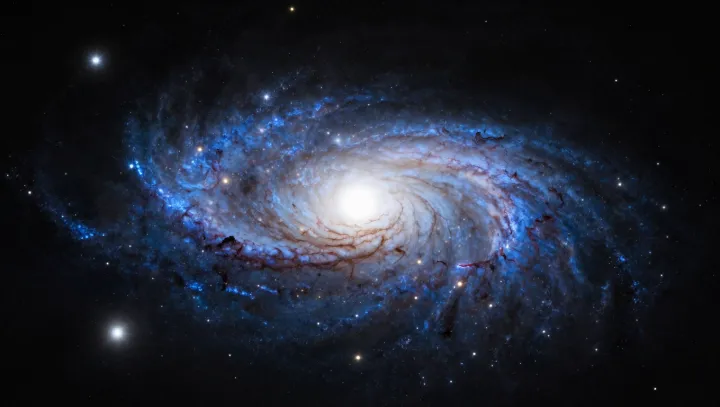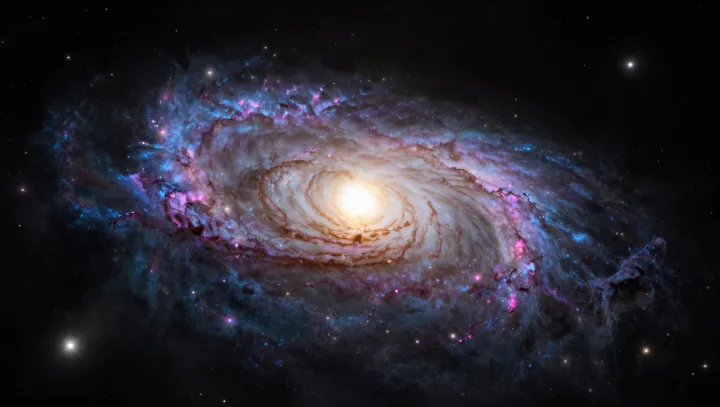
Empty space, not galaxies, stole the headline. Sky maps built from wide‑angle surveys showed that distant galaxies were not just receding; their recession rate increased with distance in a pattern only consistent with accelerated expansion driven by something uniform and unseen.
That conclusion is bolder than most astronomers like to admit. The detailed clustering of galaxies, encoded in baryon acoustic oscillations and the broad Hubble diagram of supernova distances, matches a model in which a term identical to Einstein’s cosmological constant dominates the energy budget of the universe and exerts negative pressure. Treating this as vacuum energy, quantum field theory predicts contributions many orders of magnitude larger than observed, exposing a severe fine‑tuning problem rather than a neat fit between data and theory.
The uncomfortable verdict from the maps is simple. Geometry wins over intuition. Measurements of large‑scale structure and cosmic microwave background anisotropies converge on a universe where dark energy behaves almost exactly like a constant energy density in spacetime, yet no agreed microscopic mechanism, from scalar fields to modified gravity, has survived as a clear favorite.