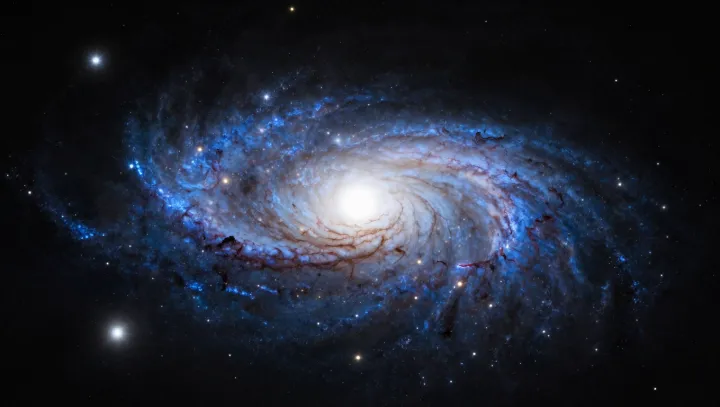
This quiet spiral is lying. Its graceful blue arms suggest ordinary gravity sourced by ordinary stars, yet its motion betrays a massive invisible scaffold that dominates the system. When astronomers map the galaxy’s rotation curve, they find flat speeds far from its luminous disk, where Newtonian expectations from visible baryonic mass predict a sharp decline. The starlight thins out, but the orbital velocity does not, implying an extended halo of unseen matter providing the extra gravitational potential.
The unsettling part is how little of this story belongs to familiar physics. Photons from the galaxy, traced across the sky, bend background light more strongly than its stellar mass and interstellar gas can justify, a classic gravitational lensing signal of excess mass. Spectroscopy and stellar population models account for the luminous contribution; the tally still comes up short by a large factor, leaving dark matter as the dominant term in the mass budget. No direct detection experiment has yet registered a convincing interaction with these hypothesized particles, whether framed as weakly interacting massive particles or axion-like candidates, so the galaxy’s rotation and lensing remain the most persuasive witnesses to a presence that refuses to appear in any detector.