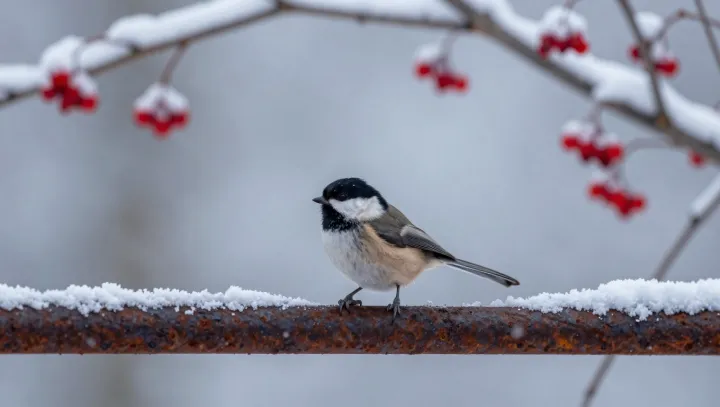
Two nickels' worth of bird can make winter look less like a contest of strength than an exercise in disciplined accounting. A chickadee-sized body faces lethal heat loss after dusk, yet it does not merely endure. It turns plumage, memory, and metabolism into a compact survival system.
The feather coat is its first, and decidedly underrated, defense. By erecting contour feathers, the bird traps a layer of still air against its skin; that insulation slows convective heat loss while its high resting metabolic rate supplies warmth. Small frame. Large problem. A surface area that sheds heat quickly demands nearly constant feeding, which is why cached seeds are not a charming habit but a reserve inventory. Spatial memory, supported by the hippocampus, lets the bird recover scattered stores when snow buries ordinary forage. Each retrieval avoids a long, costly search.
Night brings the bolder bargain. Rather than holding daytime temperature at all costs, many small resident birds enter regulated nocturnal hypothermia, lowering body temperature by a few degrees and cutting energy demand. No magic. Less thermal gradient means slower heat loss, although waking requires fuel and leaves less margin if cold intensifies. The bird survives by joining three imperfect tools, not by possessing one heroic trait. Under dark branches, a tiny furnace runs lower, guarded by air, seed, and recall.