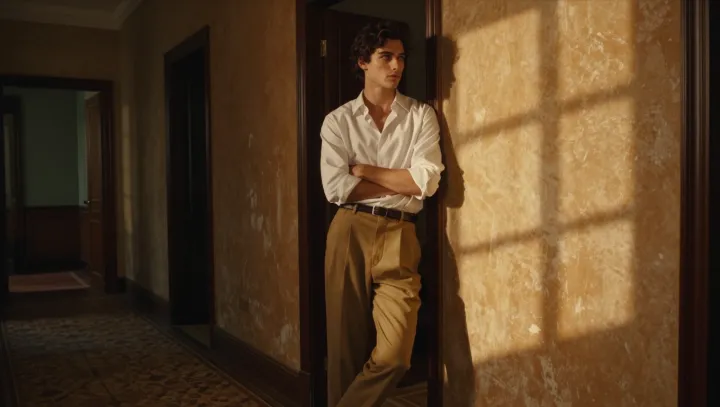
White cotton wins attention. That is why the pairing of a white shirt and high-waisted trousers remains fashion's most dependable optical trick: it reorganizes what the eye measures before personal taste enters the room. The formula looks severe. Yet the shirt forms a bright upper plane, and the raised waistband redraws the apparent origin of the legs.
The effect is more calculated than it looks. Against darker or saturated trousers, the shirt benefits from simultaneous contrast, a perceptual effect in which adjacent tones alter perceived brightness; the torso therefore reads as cleaner, sharper, and easier to separate from its surroundings. Then comes the longer line. When the waistline climbs, optical proportion changes: the hip-to-floor distance gains visual priority, while the torso is assigned less length. It is silhouette engineering, performed with cloth rather than a tailor's blade.
That economy deserves respect. Fashion often mistakes complication for distinction, although vision rewards hierarchy: light above, a line at the waist, and length below. Nothing needs ornament. The result is neither magic nor a rule of beauty; it is a small correction to the body's visual arithmetic. The arrangement gives the wearer latitude while imposing order on the frame, which is why it can survive changes in color, fabric, and mood. In that spare division of brightness and length, clothes stop announcing themselves; they edit the body into a persuasive sentence.