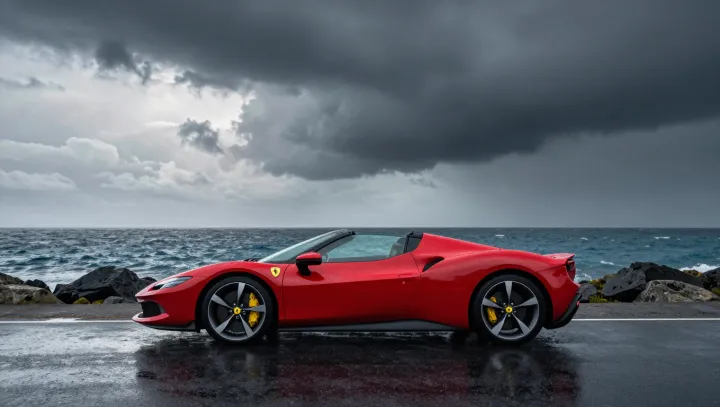
Red was never Ferrari's sales pitch. Before it became a showroom signal, the shade marked Italian entrants under motor racing's national-color convention; Ferrari inherited a rule and wore it so persistently that regulation hardened into public recognition. The paint came first. Meaning came later.
That accident of origin proved more valuable than a commissioned logo. In motor sport's early visual grammar, color enabled rapid identification: British cars wore green, French entries blue, German machines silver, and Italian teams red. Ferrari transformed this inherited code into semiotics, then into brand equity. The code traveled well. Race victories attached emotion to pigment, while road cars carried that emotional residue beyond circuits and into garages, posters, and childhood memory. No advertising launch could buy that authority, because it existed before the sales story. A red Ferrari could announce affiliation before its badge was read.
Yet the color's force lies in constraint, not choice. Ferrari cannot treat red as a seasonal ornament without weakening an association accumulated across generations; its pricing power rests partly on repetition, disciplined scarcity, and a visual cue rivals cannot credibly claim. That matters now. The color behaves as an intangible asset, common in chemistry but rare in meaning, protected by ritual as much as by trademark. Each appearance repeats a lesson audiences have learned without instruction. Under showroom lights, an old national code still flickers: a flag stripped of its pole, carrying race memory into private desire.