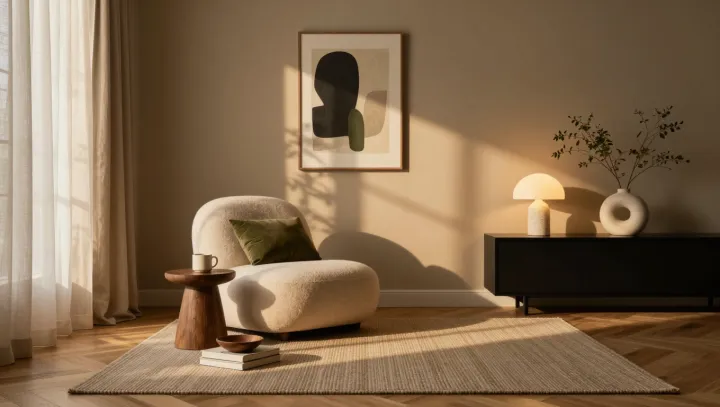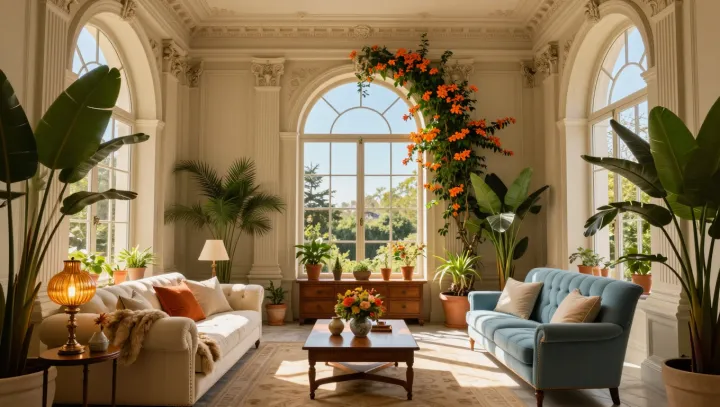
A pool of warm light can do what extra square footage cannot: make a vast room feel legible. The effect is not decorative. A sofa stops the eye. A rug declares territory. Plants interrupt a long sightline, while a lamp narrows attention to the scale at which bodies sit, talk, and rest.
Empty grandeur is often a perceptual failure, not a luxury. Eyes read rooms first. Spatial cognition relies on visual segmentation: the brain groups edges, textures, and boundaries into manageable units, even when walls offer no help. A low sofa creates an enclosure; its back becomes a horizon at seated height. A rug supplies a distinct ground plane. Plants add partial screening, a cousin of prospect-refuge theory, which links comfort to seeing outward while retaining a sense of cover.
Light does the quietest work. Warm lamps create a luminance gradient, concentrating visual weight near chairs and tables rather than leaving it scattered across a ceiling and distant corners. The room is not actually smaller. It has been edited. That concentration reduces the visual claim made by unused floor, a surface that otherwise reads as distance rather than invitation. Furnishings become punctuation, turning one intimidating volume into a sequence of pauses. At dusk, the far wall recedes, and the occupied corner acquires the persuasive proportions of a small world.