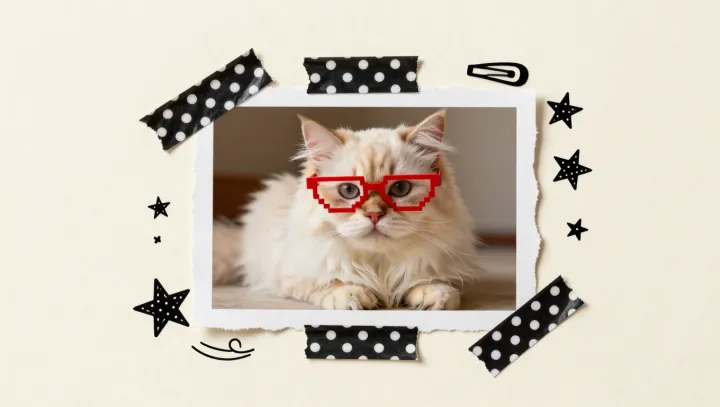
Appearance misleads at once. Behind red lenses, a cat does not acquire a scholar's eye; its visual system is built to register a flicker, a crossing shadow, or the abrupt break between mouse and ground before it resolves whiskers or fur. Motion wins the argument.
Detail is not king. Cats possess lower visual acuity than humans, because their retinas place greater emphasis on rods, photoreceptors that perform well in dim illumination, than on the dense cone arrangements that support crisp discrimination. Contrast sensitivity matters more. Retinal ganglion cells transmit changes in luminance and movement, allowing a small prey animal to announce itself even when its outline remains imperfect. The tapetum lucidum helps. That reflective layer behind the retina returns unabsorbed light through photoreceptors, an optical economy suited to scant illumination rather than miniature print. This is a hunter's bargain.
That bargain is sensible. A cat is not reading a book; it is parsing an unstable scene in which prey pauses, runs, and disappears, so binocular vision, peripheral detection, and rapid response outrank the fine resolution humans prize. Color takes a back seat. With fewer cone types than human color vision, feline sight favors usable separation over a rich range of hues. The glasses remain theater. In a room gone still, the animal's gaze can seem almost contemplative, though its attention waits for one tiny thing to move.