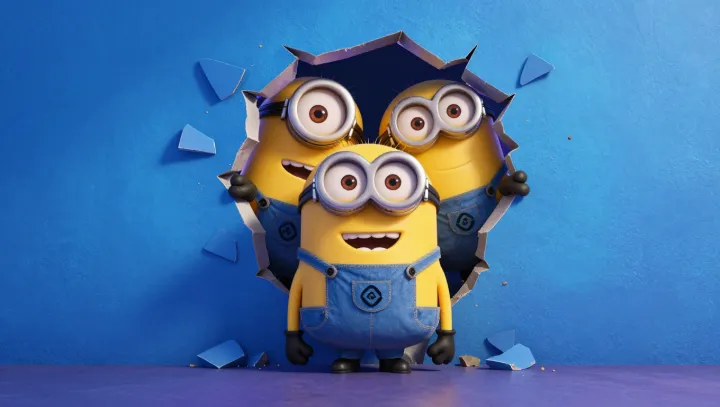
Recognition comes first. Yellow fills the frame before a word lands: a pill-shaped body, blue overalls, goggles, and a mouth stretched into alarm or delight give Minions an unfair visual advantage. They can be sorted in a glance, even when their chatter refuses translation. This is perceptual engineering, not merely character writing.
The advantage is blunt. In object recognition, the visual cortex privileges coarse shape and edge contrast before it resolves fine detail; Minions exploit that sequence with a silhouette that survives blur, distance, and crowded screens. Their yellow-blue pairing creates chromatic contrast, while goggles flag a face at once. It resembles a packet header in a network protocol: language may arrive garbled, but identity has already been routed. Facial-action coding finishes the work. Enlarged eyes, exposed teeth, and sharp brow shifts transmit emotion with little interpretive labor.
Nonsense is useful cover. Because viewers cannot lean on dialogue, gestalt grouping and feature binding carry the load, welding color, contour, and expression into one rapid judgment. The effect reaches beyond animation: a mascot built from stable cues can cross markets without much linguistic repair. Across posters, toys, thumbnails, and motion, the same few markers remain intact. The lesson is slightly merciless: charm is optional after the first second, whereas an unmistakable signal is not. The screen gets smaller. Attention fractures. Characters that endure may act less like speakers than visual signals, recognized before language gets a chance to object.