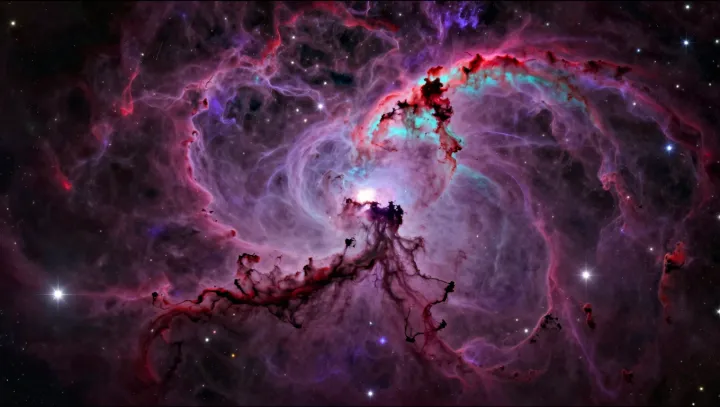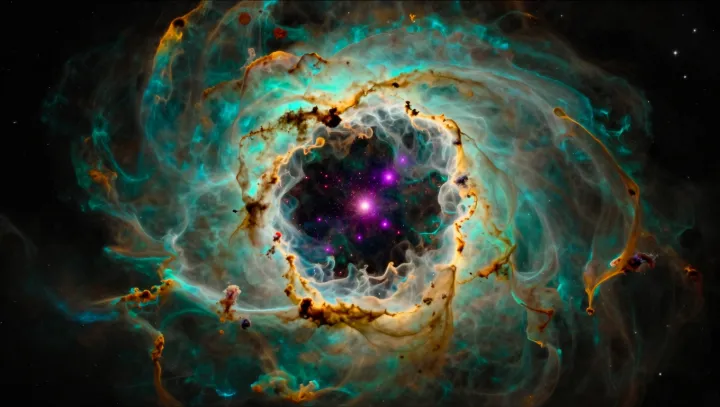
A spinning disk of gas around a black hole looks like a recipe for chaos, yet observations keep revealing structures that persist in a remarkably ordered way. The puzzle is how a cosmic vortex can stay coherent while it is being pulled inward by gravity, stirred by turbulence, and bombarded by its own radiation.
The key lies in how angular momentum is redistributed inside the accretion disk. Gas orbits faster closer to the black hole, creating shear that drives plasma turbulence. Through the magnetorotational instability, weak magnetic fields thread the ionized gas and act as a kind of viscosity, transporting angular momentum outward while allowing mass to spiral inward. This process pushes the system toward a quasi steady state rather than complete breakup.
General relativity further shapes this stability, dictating precise orbital frequencies and an innermost stable circular orbit that defines where the disk can exist. Radiative cooling balances viscous heating so the disk’s pressure, density, and temperature profiles remain in near hydrostatic equilibrium. Over long intervals, these competing processes establish something like a self-regulating entropy budget, locking the disk into a configuration that can endure even as individual gas parcels are steadily consumed.