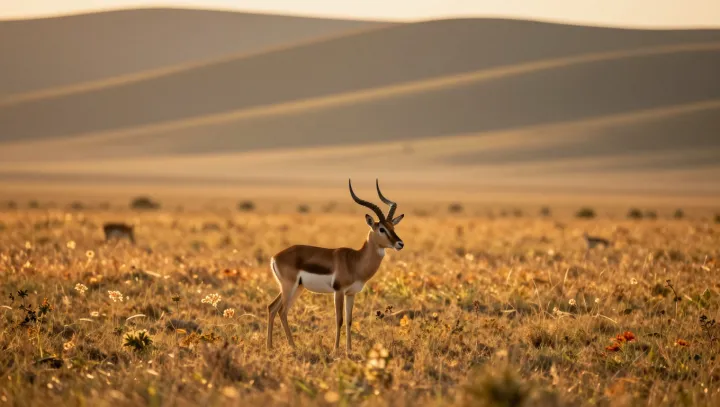
A springbok’s pronk looks like the worst idea in a race: straight legs, arched back, repeated vertical jumps while a cheetah accelerates behind it. Yet this strange, zigzagging display emerges as a survival strategy, not a glitch, in the predator–prey system of open grasslands.
Biomechanics shifts the story. A cheetah’s musculoskeletal design and high basal metabolic rate deliver explosive acceleration in a straight line but create sharp costs for rapid turning and repeated course corrections. Each springbok pronk disrupts a clean pursuit curve, forcing the predator into abrupt yaw changes that bleed momentum and increase mechanical load on joints and spine. By hopping high and unpredictably, the springbok advertises muscular power and aerobic capacity, signaling that any chase will impose a steep energy budget and high injury risk on the hunter. In evolutionary game theory terms, pronking alters the payoff matrix: it nudges cheetahs to abandon the run before contact, conserving the springbok’s limited stamina while leveraging the cheetah’s narrow optimization for straight-line sprinting.
What looks like wasted motion becomes a negotiation in midair, written in oxygen debt, friction and risk tolerance, long before claws and horns ever meet.