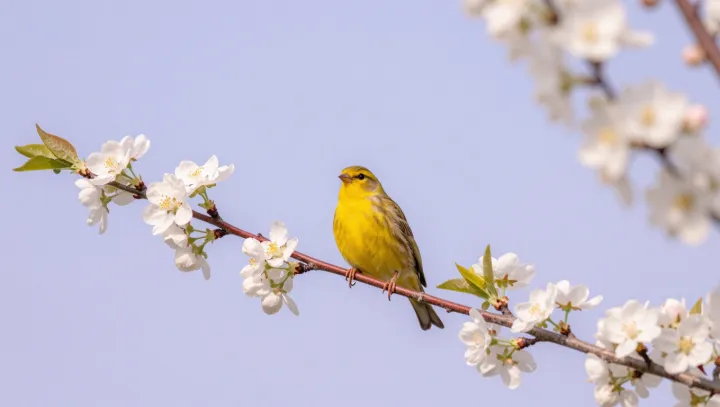
Against dense summer foliage, the Eurasian golden oriole looks both obvious and almost absent. Its plumage stays intensely yellow while predators routinely miss it, a paradox that turns out to be more about physics and perception than simple color contrast.
The bird’s feathers are saturated with carotenoid pigments extracted from insects and fruit, then locked into keratin during molt. These pigments absorb certain wavelengths and reflect mainly yellow, and feather microstructure further tunes light scattering. Regular replacement through molting prevents photodegraded pigments from dulling, so the apparent brightness can be maintained across seasons as long as diet and feather integrity support that pigment load.
Camouflage emerges from context. In canopy light, dominated by green and yellow wavelengths, the oriole’s spectral reflectance is surprisingly close to sunlit leaves, especially when viewed at distance. Predators often rely on motion parallax and edge detection more than hue discrimination, and the bird’s slender profile and habit of perching among leaf clusters break up its outline. Avian visual systems process contrast relative to background luminance, so a static oriole in dappled light generates low signal-to-noise against foliage, even though to human observers at close range the plumage looks almost fluorescent.
Sexual selection adds another layer: bright carotenoid display can signal immune function and oxidative stress resistance, yet the same pigment set can operate as background-matching camouflage under specific illumination and viewing geometry. The oriole effectively runs a dual-use strategy, using the same biochemical toolkit for both mate signaling and predator avoidance, with environmental optics deciding which function dominates at any given moment.