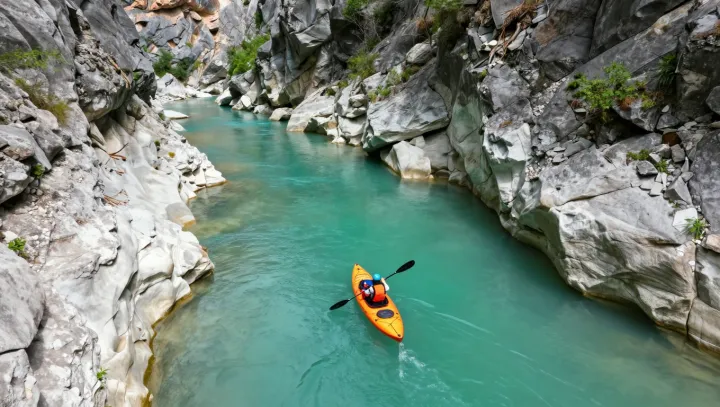
A floating tree trunk once simply followed the current; an Olympic sprint kayak now rides on the edge of capsizing with every stroke. The journey between them is a story of trading passive stability for controlled instability, guided by buoyancy, drag, and the stubborn limits of human power output.
Early dugout canoes merely increased displacement, letting Archimedes’ principle do the work: more volume, more upward force, more forgiveness. As paddlers demanded speed, designers began shaving away hull width to cut wetted surface area and viscous drag. The cross‑section flattened, then sharpened, until the boat behaved less like a barge and more like a narrow hydrofoil, flirting with planing when driven hard.
Hydrodynamic stability, once a default, became a design variable. A wide hull has a generous metacentric height and resists roll; a sprint kayak compresses that margin so that tiny shifts in the paddler’s center of mass produce rapid, precise edging. Laminar flow along the hull depends on clean, symmetric strokes. One misplaced blade loads the boat with asymmetric torque, tips the balance of angular momentum, and the same physics that once kept a log serenely upright now snaps the kayak into the water.