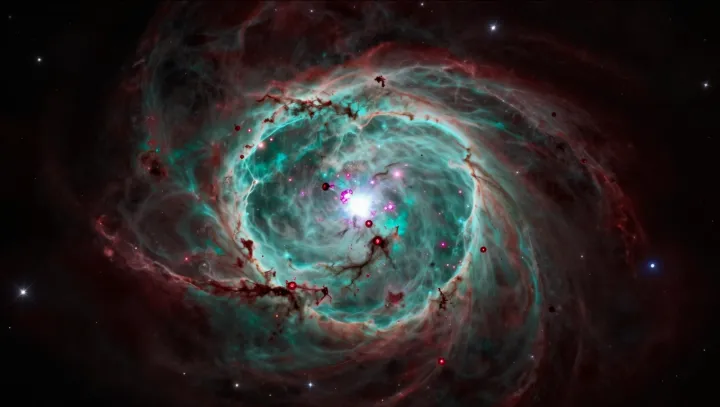
A patch of night sky that looks almost empty to the naked eye can explode with stars on a smartphone screen after a few seconds of exposure. The difference is not romance; it is physics and signal processing.
Human vision relies on photoreceptor cells that operate under strict limits of temporal integration and baseline noise. Your retina effectively resets many times each second, discarding most of the scarce photons arriving from faint stars. By contrast, a smartphone image sensor can run a long exposure, allowing its photodiodes to accumulate incoming photons over an extended interval, increasing the signal-to-noise ratio for extremely dim sources.
Mounted on a ten-dollar tripod, the camera stays stable enough to avoid motion blur while the shutter remains open. During that time, onboard algorithms apply noise reduction and, in many devices, computational photography techniques such as multi-frame stacking. Each frame captures a slightly different sample of photon arrivals and readout noise; when the processor aligns and averages them, random noise tends to cancel while consistent star signals reinforce, a textbook case of improving the signal-to-noise ratio through statistical averaging.
The result is a synthetic view that compresses many moments of light collection into a single image. Where your visual system enforces a fast, energy-efficient refresh cycle, the camera-plus-tripod combination behaves like a slow, patient detector, integrating weak stellar signals until they cross the threshold of visibility.