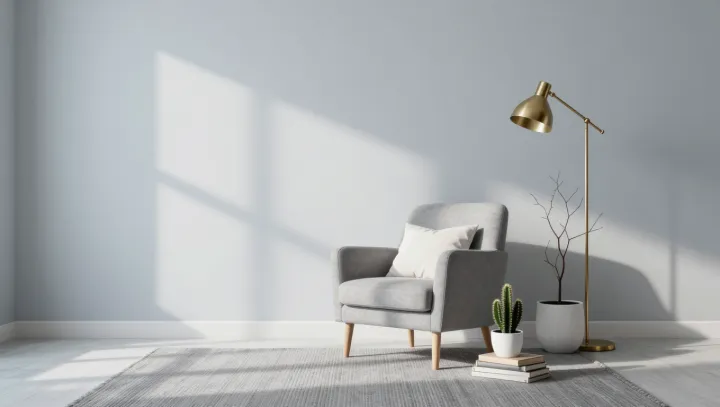
Light on a wall does not simply land; it negotiates. In a dim living room, glossy white often behaves like a mirror, bouncing a tight, specular reflection that creates hotspots and deep shadows, so the eye reads the space as patchy rather than bright.
Matte, muted paints change the physics of that negotiation. By roughening the surface at a microscopic level, they favor diffuse reflection, sending photons outward in many directions instead of a narrow beam. This soft scatter reduces luminance contrast, which matters more to perceived brightness than the raw illuminance hitting any single point. The effect is similar to a softbox in photography, where a translucent diffuser spreads a lamp’s output into an even field of light.
Color also enters the equation through spectral reflectance. Very bright whites in high gloss can emphasize glare and amplify the dynamic range between lit and unlit areas, fatiguing the eye. Slightly darker, desaturated hues paired with a matte finish can maintain high overall reflectance while smoothing the light field, so corners, ceilings, and furnishings share the glow instead of competing in a harsh visual hierarchy. In that calmer distribution, a room that once felt gloomy can register as quietly luminous.