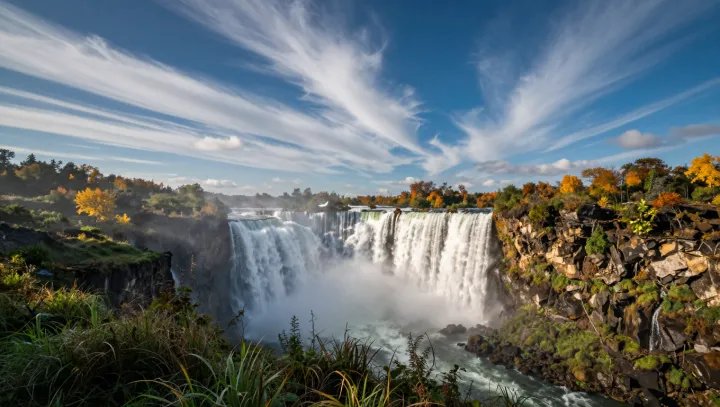
A roaring sheet of water can quietly manufacture stone. At Nuorilang Waterfall, what looks like pure motion is actually a long chemical negotiation between rock, water and air, steadily constructing the famous stone curtains that hang beneath the cascades.
The process begins upstream, where slightly acidic water dissolves limestone and carries calcium carbonate in solution. As the water plunges over the lip, it aerates violently, releasing carbon dioxide into the air. That gas loss shifts the carbonate equilibrium, pushing the water toward supersaturation. In this state, dissolved ions can no longer remain fully in solution, so calcium carbonate starts to precipitate, a textbook case of chemical equilibrium sliding toward lower free energy.
Every splash over moss, algae and rock provides nucleation sites, where tiny crystals can first attach. Layer by layer, these microcrystalline coatings grow into porous travertine, a form of sedimentary rock familiar from karst springs and cave speleothems. Thin films of water repeatedly wet and drain the surfaces, much like a high-frequency deposition cycle in materials science, and each cycle leaves behind another microscopic veneer of mineral. Over long intervals, these veneers thicken into ribs and curtains that appear to have been carved, yet are really the cumulative record of countless precipitation events.
Flow rate, water temperature and the base level of dissolved inorganic carbon all modulate the growth curve, altering how quickly the curtains advance outward. Where turbulence is intense and carbon dioxide degassing is efficient, travertine accretion can outpace erosion, allowing delicate overhangs to persist. In calmer rivulets, the same calcium carbonate budget yields subtler terraces and dams, demonstrating how a single mineral system, governed by thermodynamics and fluid dynamics, can sculpt dramatically different architectures within one waterfall.