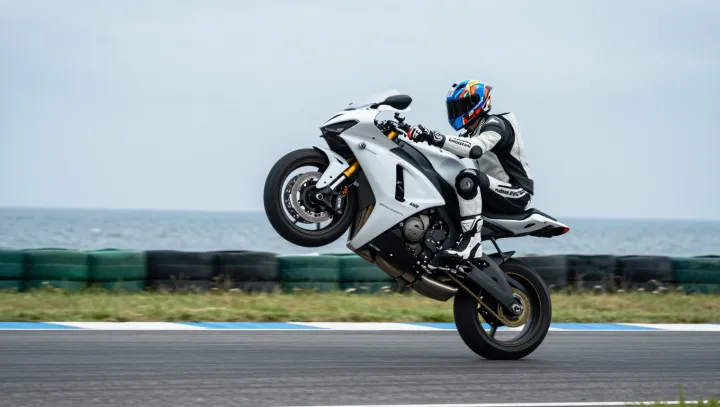
Every landing sends several times a rider’s body weight through the chassis, the suspension and then the spine, yet the rider’s decisions stay precise enough to choose a line in a fraction of a second. The apparent contradiction is now a core question for sports scientists studying high‑impact riding.
The answer starts in the vestibular system, the inner‑ear network that tracks head acceleration. With training, riders refine vestibulo‑ocular reflexes so the eyes lock on the track while the body moves underneath, reducing retinal slip and stabilizing vision during impacts. Proprioceptors in muscles and joints add continuous data about limb position, feeding spinal reflex arcs and cortical motor areas to update balance before conscious awareness can catch up.
Neuroscientists describe this as the brain running internal forward models, a form of predictive coding that estimates how the next impact will move the body and pre‑loads corrective muscle patterns. Repeated exposure reshapes synaptic connections through neuroplasticity, lowering reaction times and hard‑wiring these models into procedural memory. At the same time, attentional networks in the prefrontal and parietal cortex filter noise, suppressing non‑essential sensations so that only throttle feel, front‑wheel traction and track texture reach conscious decision‑making. Brute impact is handled by spinal and subcortical circuitry, freeing the rider’s limited cognitive bandwidth for line choice and race strategy.
Physiologists also point to autonomic regulation: trained riders control heart rate variability and breathing patterns, damping stress responses that could flood the system with distracting arousal. The result is not a tougher body so much as a reorganized control hierarchy, in which low‑level circuits absorb the chaos of landing and the conscious mind stays relatively still, suspended above the noise of the track.