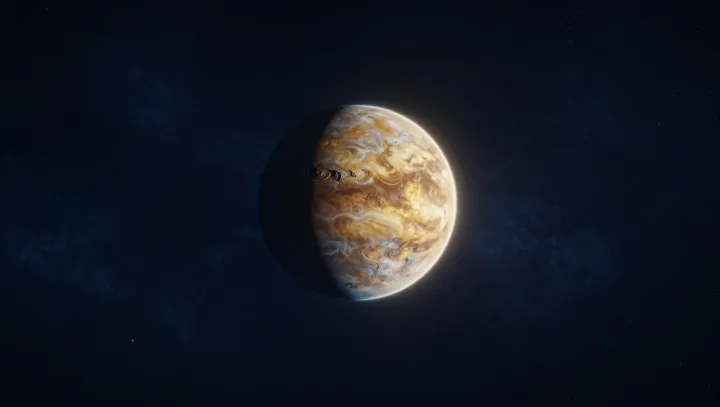
A blank sky is the real scandal here. Venus orbits the Sun with no natural satellite at all, yet search boxes fill with queries about a mysterious Venus moon, sometimes even misspelled as “Venuss satellite,” as if an entire world were being hidden behind some cosmic firewall.
The core problem is simple hype, not secret physics. Planetary dynamics show that Venus’s slow retrograde rotation and proximity to the Sun make long‑term orbital capture of a moon dynamically unstable, a point backed by orbital mechanics simulations and repeated radar mapping campaigns that have never revealed a bound natural companion.
The persistence of the myth says more about digital culture than about celestial mechanics. Old speculative papers, low‑resolution observations, and click‑driven videos get algorithmic leverage; once a phrase like “Venus has a hidden moon” gains engagement, ranking models treat it as demand, feeding a closed‑loop of repetition that buries the boring, verified answer from space agencies and peer‑reviewed catalogs.
The odd spelling “Venuss” acts like a fossil of that process. It often traces back to scraped captions, auto‑translated posts, and low‑quality content farms that copy one another, building a kind of misinformation moat around the topic, where the same error signals to the search system that this phantom satellite is a thing worth serving to the next curious user.