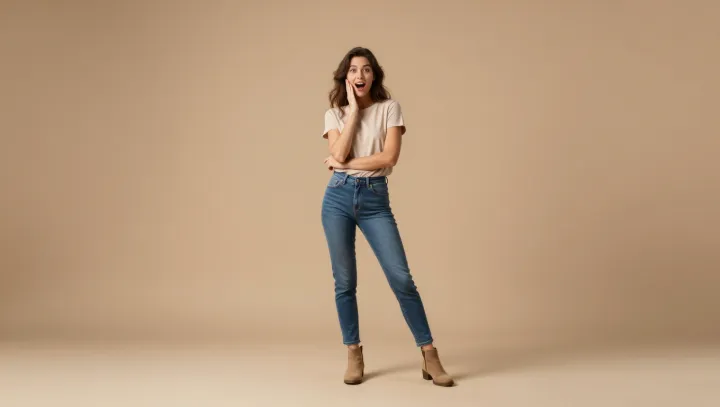
One pair of jeans often works harder than an entire wardrobe. A straight mid-rise, pale seam shadows, a slightly worn hem: this neutral template behaves like blank graph paper where proportion, not product, becomes the main story.
Style insiders quietly treat that single pair as a live experiment. Shift the cut from pooled over the shoe to a sharp crop and the leg line changes from column to exclamation point, redistributing visual weight the way basic figure-drawing manuals map the human body with vertical axes and balance points.
A tight, high cuff does something bolder than showing ankle. It slices the silhouette at a deliberate coordinate, raising the perceived knee and shortening the calf, which makes chunky boots look intentional rather than heavy. A loose roll, by contrast, lowers the breakpoint, echoing menswear tailoring and making flats read more relaxed than sloppy.
Contrast finishes the experiment. Dark denim against a pale top shifts the body’s visual center of gravity downward, grounding the hips; flip the values and the eye climbs toward the shoulders, which is why the same jeans with a black blazer can fake extra height. With every micro-adjustment, the garment stays constant, yet the mapped body and the mood feel entirely rewritten.