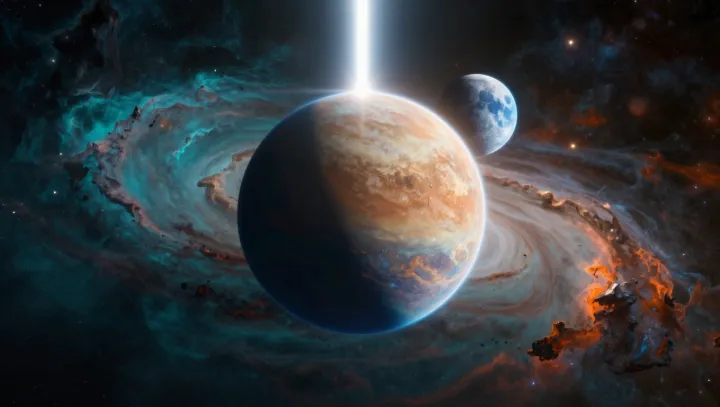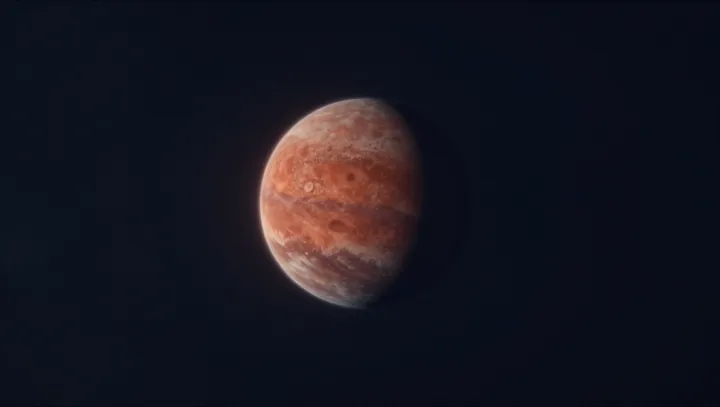
Closest to that nightmare description stands HD 189733b, an exoplanet that makes Mercury look almost modest. Locked in a tight orbit around a star slightly smaller than the Sun, this gas giant sits so near its primary that its dayside temperature soars high enough to vaporize silicates, the same minerals that make up common glass on Earth, turning its atmosphere into a brutal chemical workshop.
What sounds like science fiction rests on sober spectroscopy. Astronomers have measured starlight filtering through the planet’s atmosphere and found signatures of silicate particles and sodium, while Doppler shifts in the spectral lines reveal winds screaming across its surface at roughly seven thousand kilometers per hour. In such conditions, models of atmospheric dynamics and radiative transfer suggest that silicate vapor can condense into shards of glass, which are then whipped sideways by those supersonic jets, a far more violent process than any storm in the Solar System.
Striking, too, is how ordinary the host star appears. A relatively typical main-sequence object anchors a system whose leading planet behaves like a physics stress test, compressing tidal locking, extreme albedo contrast, and atmospheric escape into a single object. HD 189733b turns the idea of a “normal” planetary system inside out, reminding observers that our own collection of worlds, with its temperate orbits and mostly solid rain, may be the exception rather than the rule.