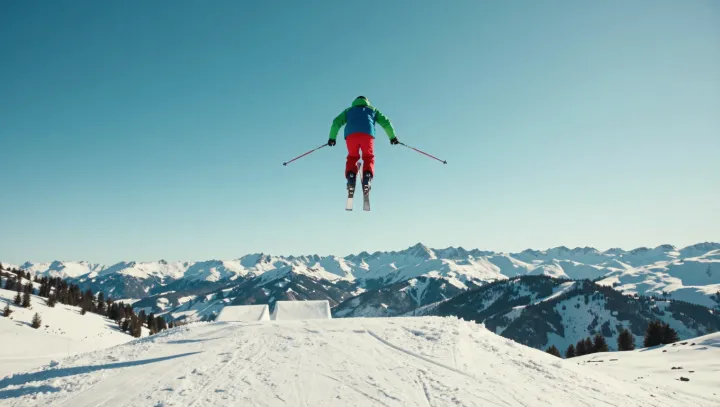
A thin steel edge, not raw courage, rules a ski carving at 60 km/h. The slope looks like ice. The physics says something else. When a ski is tipped, that edge cuts into snow grains and raises the normal force, so lateral grip scales with pressure rather than with some vague idea of slipperiness.
The odd truth is that speed helps. As the skier arcs, the turn demands centripetal force, and that demand pushes the ski harder into the surface, so frictional shear grows exactly when it is needed most, while the sidecut radius and flex pattern steer the ski like a pre‑bent rail that converts that force into a clean arc instead of a skid.
Control survives because the enemy friction is not uniform. Under the edge, micro‑melting and regelation form a thin water film that behaves like a viscous lubricant, yet the pressure peaks at the edge keep enough solid contact to prevent full hydroplaning, so kinetic friction stays high enough for grip but low enough to allow smooth redirection of momentum.
Even balance is not a matter of feel alone. The center of mass stays stacked above the resultant ground reaction force, and that vector passes through the edged ski like a structural strut, meaning the skier is not balancing on slipperiness but on a moving triangle defined by gravity, normal reaction and frictional force.