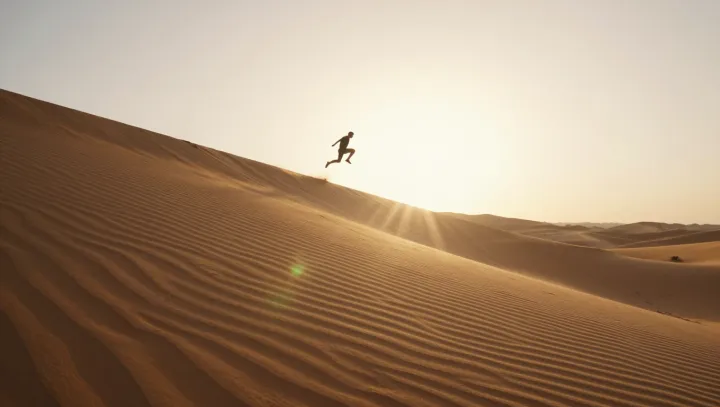
Awkward is the default look of a jump shot once a camera gets involved. Not the athlete. Not the height. Blame the frozen mismatch between the body’s center of mass and limb geometry that the sensor happens to trap in a single frame.
At the peak of a jump, biomechanics is elegant: the center of mass follows a clean ballistic trajectory, and limb segments swing in coordinated joint angles described by simple kinematics. A still image, though, samples that smooth curve as a harsh yes‑or‑no. Catch the instant just before the peak and the knees are still flexed, the hips lag behind, the arms trail; the center of mass is rising, but the limbs advertise strain, so the photo reads as heavy rather than airborne.
The problem gets worse with short shutter speed. Fast exposure eliminates motion blur, which normally hints at direction and velocity, and removes that perceptual bridge our visual cortex uses to reconstruct continuous motion. What remains is a contorted pose, center of mass still low relative to the frame, ankles dorsiflexed, elbows bent at odd angles. The actual jump may be explosive, but the sampled micro‑moment shouts hesitation.
Professional motion capture avoids this trap by tracking markers on the skeleton and reconstructing full trajectories, not isolated poses. Photography, chasing drama, often fires in burst mode and later selects the most dramatic limb spread, not the clean apex where the center of mass, torso alignment, and joint extension quietly align. The physics stays graceful; the still frame chooses the ugliest syllable of that movement sentence.