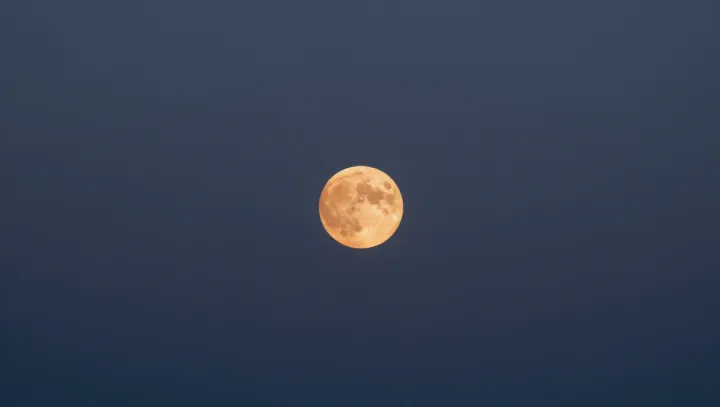
A blood‑orange Moon is not a moody Moon at all. The drama belongs to Earth. When the disk hangs low above the horizon or slips into Earth’s shadow during a lunar eclipse, moonlight must first run a gauntlet through a thick, water‑rich slice of atmosphere that edits the light before it reaches human eyes.
The counterintuitive part is simple: the color is mostly subtraction. Short, blue wavelengths are stripped away by Rayleigh scattering, the same process that gives the sky its daytime hue, while aerosols and water droplets boost Mie scattering that further weakens blues and greens. What survives that long, slant path are red and orange photons, so the Moon looks as if it has changed color, even though its airless surface reflects a nearly constant spectrum.
Earth then behaves like an enormous optical device. Its curved, humid shell refracts light into space the way a lens bends rays through glass, a process governed by Snell’s law and the refractive index of moist air. During a lunar eclipse, that bent, filtered light arcs through the atmospheric limb and softly backlights the Moon in rusty tones, an image that is really a global, back‑lit silhouette of Earth’s own water‑laden sky.