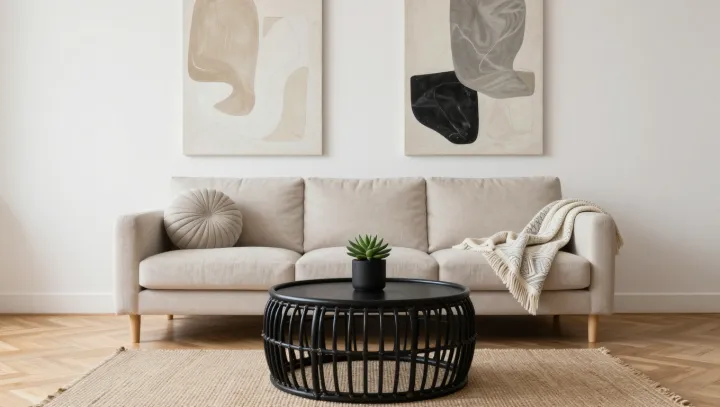
White paint is a space machine. Not a metaphorical one, a literal optical device built into your walls. When a small living room is coated in high-reflectance white, its surfaces behave like a crude light amplifier, using reflection physics to stretch every lumen that enters the room.
Central to this effect is one blunt number: about eighty-five percent. That is the approximate reflectance, or albedo, of a clean matte white wall under daylight, meaning it sends most incoming visible photons back into the room rather than absorbing them as heat. Dark finishes, by contrast, often bounce back only ten to thirty percent of that same light, acting more like light sinks than light engines. So a sunbeam that hits a white wall does not end its journey there; it ricochets across ceiling, floor, and furniture in multiple scattering events, each pass slightly dimmer but still visible to the eye.
What changes first is not the floor plan but the brain. Human visual perception estimates spaciousness from luminance gradients, contrast at room edges, and the clarity of corner boundaries. Brighter, more uniformly lit corners reduce contrast and soften shadows, which the visual cortex reads as greater depth and distance. In a white room, the extended light paths and higher diffuse reflectance flatten harsh transitions between light and dark, so boundaries recede and the envelope of the room feels pushed outward. The square footage stays fixed; the perceived volume quietly inflates.