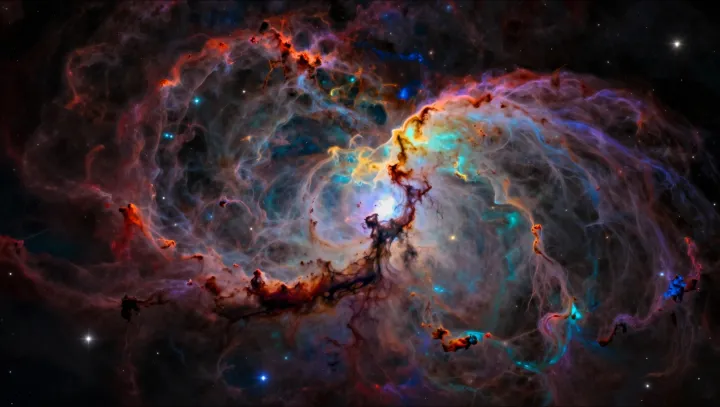
An apparently empty patch of sky is not lazy at all; it is on a knife edge. A giant molecular cloud in the interstellar medium carries so little mass in each cubic centimeter that it beats most laboratory vacuums, yet spread over light‑years this same cloud holds enough hydrogen to build thousands of suns, and its own gravity never really turns off.
The uncomfortable truth is that such a cloud is only stable until physics runs the numbers against it. When the mass inside a region exceeds the limit known as the Jeans instability threshold, self‑gravity overpowers internal gas pressure. Cooling by molecular line emission lets the gas shed thermal energy, so sound speed drops, pressure support weakens, and small density ripples grow instead of fading. One patch becomes slightly denser, pulls harder, thickens again, and the feedback loop steepens into runaway collapse toward a protostar.
Star birth, then, is less a gentle gathering than a forced takeover. External triggers such as shock waves from prior supernovae or the pressure fronts of expanding H II regions can compress the cloud just enough to push it past marginal stability. Turbulence and magnetohydrodynamic fields complicate the script but do not erase the core arithmetic: spread thinly enough, gravity waits; gathered just a bit more tightly, it dictates the next bright point in the sky.