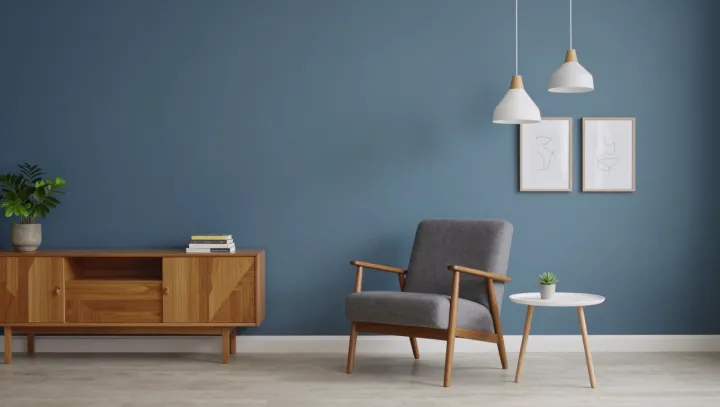
A bare wall quietly shrinks a room. Not physically. Perceptual psychology shows that large uniform surfaces starve the brain of depth cues, so corners feel closer and ceilings lower, even when measurements stay constant.
A single framed artwork or tall plant breaks that flat field and inserts what researchers call figure–ground structure, introducing edges, verticals and reference points that the visual cortex uses for size constancy and spatial scaling. When the object is placed near a corner or along the longest sightline, binocular disparity and perspective lines gain clarity, which makes the envelope of the room read as wider and longer, much like adding gridlines to a blank chart instantly clarifies its span.
The room also looks brighter even if the light level is unchanged. High‑contrast art, glossy leaves or a pale pot increase local luminance contrast, and vision science shows that contrast directly biases perceived brightness. Emotional warmth rises for a different reason: affective priming. Studies on biophilia and color psychology find that organic forms, greens, and human‑scale imagery lower amygdala activation and nudge the autonomic nervous system toward relaxation, so the same square footage registers as not just larger, but kinder.