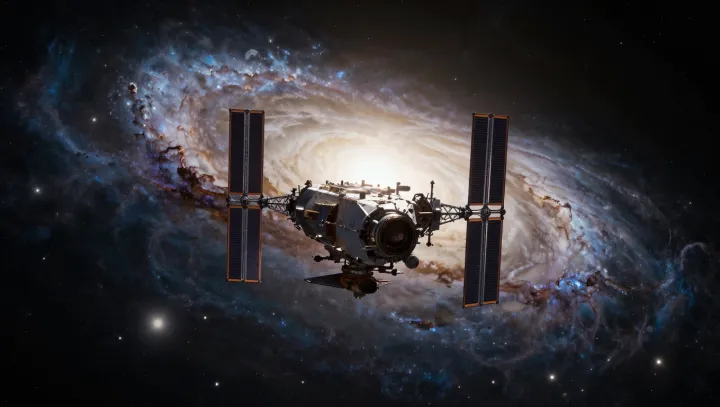
The Moon gets a snub that sounds unfair at first glance. It shares Earth’s neighborhood yet never shares a category with the machines humans throw into orbit, and that split is not about pride but about physics. As a natural satellite, the Moon formed from planetary debris and follows trajectories set by gravitational interaction and conservation of angular momentum, while every spacecraft is an engineered object whose orbit exists only because design teams exploited those same equations with hardware and fuel.
Astronomers insist on this divide because origin and control matter more than mere motion. The Moon has no propulsion system, no thrust vector control, no attitude control loop; its path is dictated by the restricted three‑body problem and by tidal forces that reshape its rotation over long intervals. A spacecraft, by contrast, couples chemical or electric propulsion to guidance, navigation, and control architectures, adjusting delta‑v in precise increments to enter, maintain, or abandon an orbit. Both circle Earth, yet only one can be steered on command, carry payloads, or fail as a mission. That difference, not the shared word satellite, is what the discipline protects.