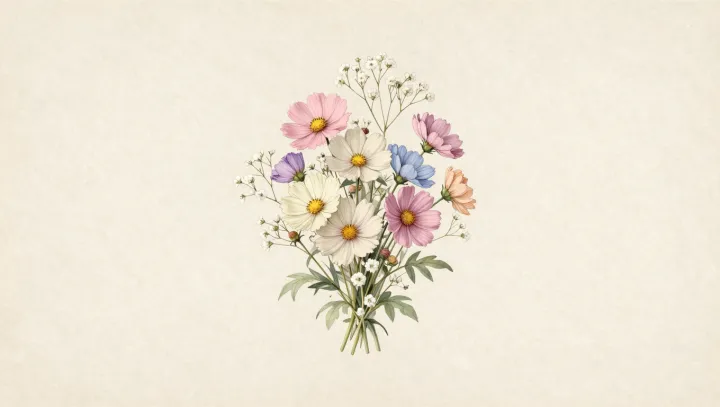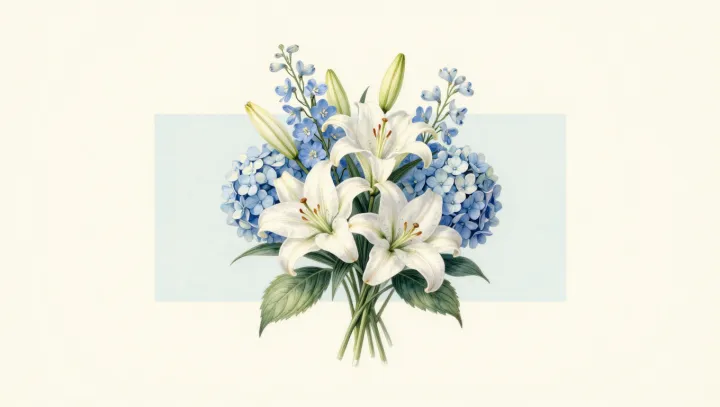
Perfect balance is a trick here; the bouquet hides a biochemical standoff. White lilies thrive in soils where pH barely matters to color, while blue hydrangea-like clusters demand acidic ground loaded with soluble aluminum ions. In hydrangeas, aluminum binds to anthocyanin pigments in sepal cells, forming metal–pigment complexes that shift light absorption toward blue, a response tightly coupled to pH-dependent ion transport in the root cortex.
More jarring is how differently these flowers court visitors. Lilies bet on scent. Heavy volatile organic compounds diffuse through still air and flag large pollinators that rely on olfaction more than color contrast. Those white tepals carry carotenoids and flavonols but suppress visible anthocyanin, creating high reflectance targets at dawn or dusk when light is low. Hydrangea-like blue heads, by contrast, often assemble sterile showy florets around fertile ones, turning the inflorescence into a structural billboard whose spectral signature sits squarely in the range detected by bee photoreceptors tuned to shorter wavelengths.
So the harmony is curated, not natural. Florists leverage human trichromatic vision, which reads blue and white as clean binary contrast, while evolution has wired these plants to answer completely different selection pressures in the rhizosphere and in the pollination network.